How Many People Can Sit at a 6-Foot Table?
By Katie, Three Sisters Party Co. ·
Six-foot rectangular tables are one of the most common choices for graduation parties, birthday celebrations, family reunions, school events, holiday gatherings, and backyard parties.
They are large enough to seat a group comfortably but compact enough to arrange in a backyard, garage, pavilion, or indoor party space. They can also be used for food, gifts, desserts, drinks, concession machines, and party activities.
The question many hosts have is simple:
How many people can actually sit at a 6-foot table?
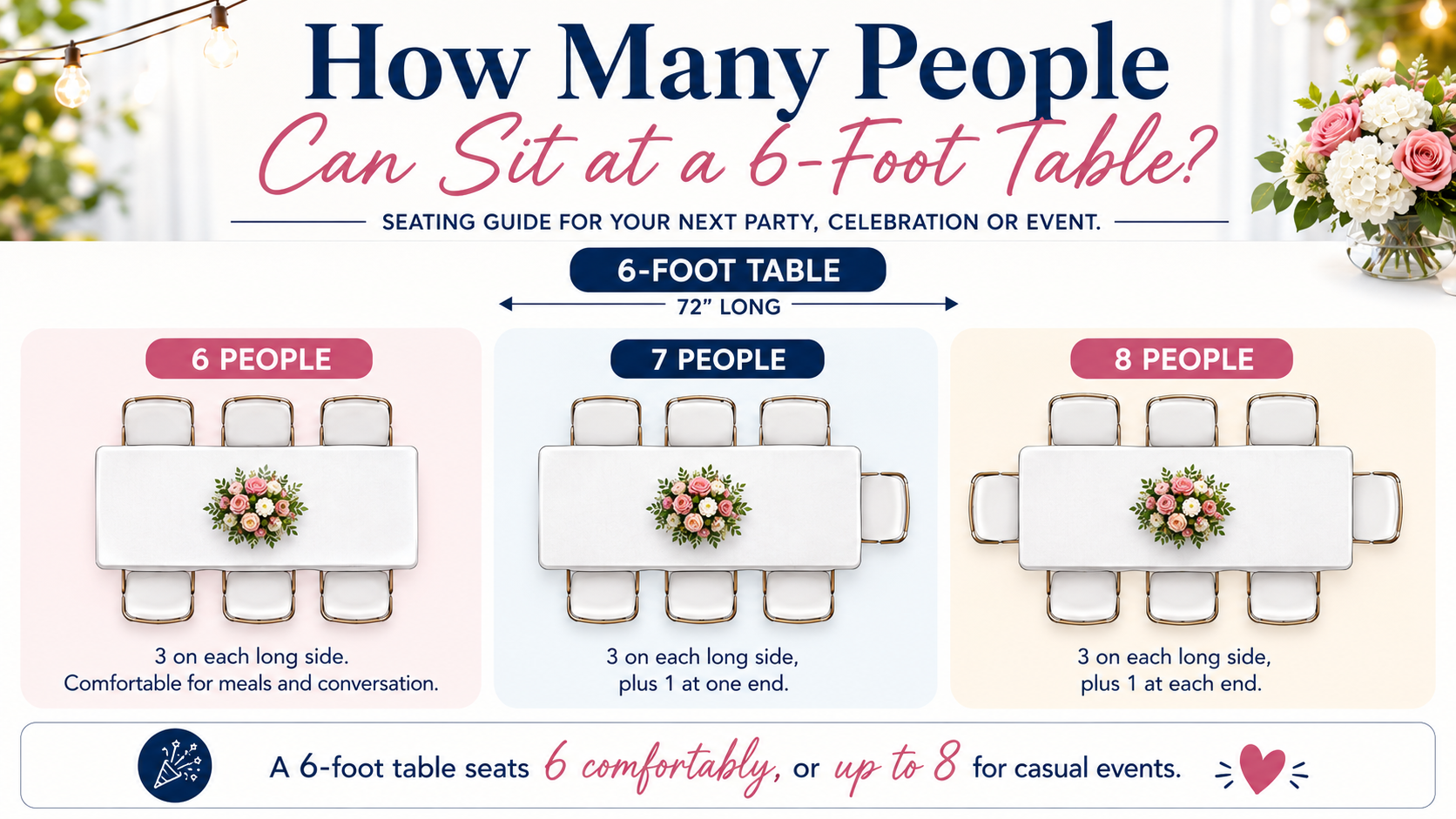
A standard 6-foot rectangular table can usually seat six people comfortably or up to eight people when the two ends are used.
That does not mean eight seats will be the best choice for every event. The right number depends on whether guests are eating a full meal, the size of the chairs, the amount of food and décor on the table, and how much room is available around it.
For families throughout Albany, Loudonville, Latham, Colonie, Delmar, Bethlehem, Saratoga Springs, Clifton Park, Niskayuna, Troy, and the surrounding Capital Region, this guide explains when six, seven, or eight seats work and how to create a comfortable party layout.
1. Six Guests Is the Most Comfortable Arrangement
The most comfortable setup for a standard 6-foot rectangular table is usually six guests.
This arrangement places three chairs along each long side of the table and leaves both ends open.
Each guest receives approximately two feet of table length. That provides enough room for a plate, drink, silverware, napkin, and normal elbow movement.
A six-person arrangement also makes it easier for guests to pull their chairs in and out without bumping into the person beside them.
This setup works especially well for a seated meal where guests will remain at the table for an extended period. It is a practical choice for graduation dinners, family meals, showers, holiday gatherings, and parties serving food that requires a full place setting.
Leaving the ends open also makes the table easier to approach. Guests can move around it without navigating around chairs placed at every edge.
2. Eight Guests Can Fit When You Use Both Ends
A 6-foot table can often hold eight guests by placing three chairs along each long side and one chair at each end.
This arrangement maximizes the seating capacity of the table.
It can work well for a casual birthday party, open-house graduation celebration, children’s event, picnic-style meal, or party where guests will not remain seated for the entire afternoon.
However, eight people will have less personal space than six.
The two guests seated at the ends may also have limited legroom depending on where the table legs and support bars are positioned. Some folding tables have braces that make the end seats less comfortable.
Before planning eight seats at every table, unfold one table and test the arrangement with the chairs you intend to use. Make sure the end chairs can be pulled close enough to the table without hitting the legs or support structure.
3. Seven Guests Can Be a Practical Compromise
Hosts often plan in groups of six or eight, but seven guests can work surprisingly well.
For seven people, place three chairs on each long side and one chair at one end.
This arrangement provides one additional seat without making both ends feel crowded.
It is helpful when families or friend groups do not divide evenly into groups of six. For example, a family of four may want to sit with three grandparents. Seating seven together can be more comfortable than separating the group simply to keep every table identical.
Using seven seats can also help with an uneven guest count.
A party with 35 seated guests could use five tables with seven guests at each table. A party with 37 guests might use four tables with eight seats and one table with five.
The tables do not all need to have the exact same number of chairs. The goal is to create a comfortable arrangement for the actual groups attending.
4. The Type of Meal Changes the Seating Capacity
The way food is served has a major effect on how many people can comfortably sit at one table.
A buffet-style meal usually requires less tabletop space because guests fill their plates at a separate food station. Once they sit down, they only need room for their individual plates and drinks.
In that situation, seating eight people at a 6-foot table may be reasonable.
Family-style meals require more room. Serving bowls, platters, bread baskets, condiments, and utensils must be placed in the center of the table. That reduces the available space for each guest.
For family-style dining, six guests will usually be more comfortable.
Formal place settings also take up more room than casual paper plates. Chargers, multiple glasses, cloth napkins, silverware, and decorative place cards can make an eight-person arrangement feel crowded very quickly.
Think about what will actually be placed on the table before deciding how many chairs to add.
5. Centerpieces Can Reduce the Usable Space
A centerpiece may look small while you are decorating, but it can take up valuable room once plates, glasses, and guests are added.
Large flower arrangements, balloon displays, framed photographs, candles, graduation decorations, and serving pieces all reduce the amount of usable tabletop space.
When seating eight people, use a smaller and lower centerpiece.
A simple vase, small floral arrangement, framed graduation photograph, or compact decoration can create a finished appearance without crowding the table.
Tall decorations can also make conversation difficult. Guests seated across from one another should be able to see each other without leaning around the centerpiece.
If you want a larger display, place it on a separate gift, dessert, or welcome table instead of the guest dining tables.
6. Chair Size Matters
Not every chair uses the same amount of space.
Standard folding chairs are usually easier to arrange around a 6-foot banquet table than wide dining chairs, chairs with arms, patio chairs, or oversized padded seating.
A narrow folding chair allows three guests to sit along each long side without the seats touching.
Wider chairs may reduce the comfortable capacity to four or six people.
Armrests can create another problem. Even when the chairs fit beside one another, the arms may prevent them from sliding underneath the tabletop.
This is one reason matching folding chairs are helpful for larger parties. Their consistent size makes it easier to predict how many will fit around each table and how much space the full arrangement will require.
Avoid mixing several very different chair styles at the same table whenever possible. The table may look uneven, and some guests may have considerably less room than others.
7. Children Need Less Space, but They Still Need a Safe Setup
A 6-foot table may seat eight children more easily than eight adults.
Children generally use smaller chairs, need less elbow room, and have smaller place settings. This can make an eight-seat arrangement practical for a birthday party, school event, craft station, or children’s activity table.
However, do not squeeze children together simply because they are smaller.
They still need enough room to sit safely, get in and out of their chairs, and avoid spilling drinks or knocking plates onto the ground.
A crowded children’s table can quickly become messy, especially when it includes crafts, games, frosting, snow cones, or other activities.
For a craft or activity table, six children may be more manageable than eight because each child needs working space.
For a quick birthday meal with simple plates and cups, eight children may fit comfortably.
8. Leave Enough Room Around the Table
The number of people who fit at the table is only part of the planning process.
You also need enough space for the chairs and for guests to walk behind them.
A table that measures only six feet long requires a much larger total footprint once chairs and people are added.
When possible, leave approximately three feet of open space behind occupied chairs. This allows a guest to pull out a chair while another person walks behind them.
Tables placed too close together can create bottlenecks. Guests may have difficulty carrying food to their seats, parents may struggle to reach children, and chairs from neighboring tables may hit one another.
Before the party, place one table and add all of the planned chairs. Pull the chairs out as though guests are seated. Then walk around the arrangement.
This simple test gives you a much more realistic understanding of the space than measuring the folded table alone.
9. Avoid Placing Every Table in One Long Row
Placing several 6-foot tables end to end can create one long banquet table.
This may work for a formal family meal, but it is not always the best arrangement for a casual backyard party.
A long row requires more continuous space and can make conversation difficult between guests seated far apart. It may also create traffic problems when people need to move around the ends.
Separate tables often provide more flexibility.
Groups of six to eight guests can sit together, tables can be placed around natural yard features, and open walkways can remain between the seating areas.
Separate tables are also easier to move if the weather changes or part of the party must be brought into a garage, covered patio, or indoor room.
For a graduation open house, several smaller seating areas can feel more relaxed than one assigned dining arrangement.
10. Match the Seating Plan to the Type of Party
A sit-down meal and an open-house celebration should not use the same seating formula.
For a sit-down meal, provide a chair and a planned place at a table for every guest. Six guests per 6-foot table will usually provide the most comfortable arrangement.
For an open-house graduation party, guests arrive and leave at different times. Not everyone will need a dining seat simultaneously.
In that situation, you may use a combination of table seating and separate conversation chairs.
Some guests will eat at the tables, while others stand near the games, visit the concession station, or talk with family members in another part of the yard.
For a children’s birthday party, the children may need table seating for food and cake while adults use chairs placed nearby.
Think about how guests will use the event space instead of automatically dividing the total guest count by eight.
11. How Many 6-Foot Tables Do You Need?
The number of tables depends on whether you plan to seat six or eight guests at each one.
| Seated guests | Tables at 6 per table | Tables at 8 per table |
|---|---|---|
| 24 guests | 4 tables | 3 tables |
| 30 guests | 5 tables | 4 tables |
| 40 guests | 7 tables | 5 tables |
| 50 guests | 9 tables | 7 tables |
| 60 guests | 10 tables | 8 tables |
| 75 guests | 13 tables | 10 tables |
| 100 guests | 17 tables | 13 tables |
These numbers only account for guest seating.
Most parties also need separate utility tables for food, drinks, gifts, desserts, coffee, concessions, or party supplies.
For example, a 50-person seated party may need seven to nine dining tables plus two or three additional tables for the buffet, gifts, and drinks.
Do not use every available table for seating and then discover there is nowhere to place the food.
12. Plan Utility Tables Separately
A table used for food or supplies should not be counted as a guest seating table.
Common utility-table uses include the main buffet, desserts, gifts and cards, beverages, coffee, concession machines, party favors, and children’s activities.
Not every event needs a separate table for every category.
A smaller birthday party might combine gifts and favors on one table. A graduation party may need a dedicated gift table because cards, photographs, keepsakes, and decorations require more room.
The food buffet may need more than one table if you are serving several hot dishes, salads, desserts, and paper products.
Planning utility tables separately prevents overcrowding and makes the final rental estimate more accurate.
13. Choose the Tablecloth With Seating in Mind
The tablecloth can affect how comfortable the seating arrangement feels.
A moderate tablecloth drop works best for guest seating. It creates a finished appearance without placing excess fabric around guests’ legs.
A floor-length tablecloth is usually better for a gift, dessert, cake, or display table than for a table surrounded by chairs.
If you plan to seat guests at the ends, make sure the tablecloth does not bunch around their knees or make it difficult to pull the chairs underneath the table.
For most 6-foot guest tables, a 60 × 102-inch tablecloth provides an even and practical drop.
For complete sizing information, read our guide to choosing the correct tablecloth for a 6-foot table.
14. Understand What Is Included With the Rental
Three Sisters Party Co. provides heavy-duty 6-foot folding tables and matching chairs for celebrations throughout the Capital Region.
Tables and chairs are rental only. Customers are responsible for placing, arranging, and setting them up unless another service has been specifically confirmed.
Before your event, decide how many guests you want at each table and create the layout while the yard or party space is still empty.
Do not wait until guests begin arriving to determine whether the chairs will fit.
When checking availability, provide your event date, full address, approximate guest count, number of tables and chairs requested, and whether you are interested in pickup or local delivery.
Frequently Asked Questions
How many people can sit comfortably at a 6-foot rectangular table?
Six adults can usually sit comfortably, with three chairs placed along each long side.
Can eight people fit at a 6-foot table?
Yes. Place three guests on each long side and one guest at each end. This arrangement works best for casual events with simple place settings.
Is six or eight people better?
Six is more comfortable for a full meal or formal place settings. Eight is useful when maximizing seating at a casual party.
Can seven people sit at a 6-foot table?
Yes. Place three chairs on each long side and one chair at one end. This can be a useful option when family groups or guest counts do not divide evenly.
How many children fit at a 6-foot table?
Eight children may fit comfortably for a simple meal. For crafts or activities that require working space, six may be a better choice.
Do people seated at the ends have enough legroom?
That depends on the table’s folding legs and support bars. Test the end seats before the event to make sure the chairs can be pulled close to the tabletop.
How much space should I leave between tables?
Allow enough room for chairs to pull out and for guests to walk behind them. Approximately three feet behind occupied chairs is a practical goal when space permits.
How many 6-foot tables do I need for 50 guests?
You will need approximately seven tables when seating eight per table or nine tables when seating six per table. Add separate tables for food, gifts, drinks, and desserts.
Are setup and table arrangement included?
Tables and chairs are rental only. Customers arrange and set them up unless another service has been specifically confirmed.
Choose Comfort Before Maximum Capacity
A standard 6-foot rectangular table can seat six people comfortably or as many as eight when the end seats are used.
For a full meal, formal place settings, or larger adult guests, six seats will usually provide the better experience.
For a casual graduation party, children’s birthday, picnic-style meal, or event with limited space, eight seats may work well.
The best arrangement is not simply the one that fits the most chairs. It is the one that allows guests to sit, eat, talk, and move comfortably.
Three Sisters Party Co. provides tables, chairs, concession machines, backyard games, and party add-ons for graduation parties, birthdays, school events, family reunions, and backyard celebrations throughout Albany, Colonie, Loudonville, Latham, Delmar, Bethlehem, Saratoga Springs, Clifton Park, Niskayuna, Troy, and the surrounding Capital Region.
View our Packages and Pricing, use the Party Rental Calculator, or check availability for your event date and address.
See packages and pricing, try the party rental calculator, or check availability.