How to Keep Kids Engaged During a Birthday Party
By Katie, Three Sisters Party Co. ·
Quick Answer
Kids stay engaged when you stagger activities to match their energy and use games and treats as natural focal points. Three Sisters Party Co. rents backyard games and concession machines that keep Capital Region parties fun from start to finish. Most rentals are customer setup, with pickup and local delivery available when possible.
There is a moment at almost every kids' birthday party when the energy shifts.
The first thirty minutes were great. Kids arrived excited, played a game or two, and burned through their initial burst of enthusiasm. But now they are standing around, asking what is next, and the party still has an hour to go.
This is the engagement gap, and it is one of the most common challenges parents face when hosting.
The good news is that keeping kids engaged does not require a packed schedule or professional entertainment. It requires understanding how children's energy works and setting up the party to match their natural rhythm.
Understanding the Energy Curve
Kids do not maintain a steady level of energy throughout a party. Their enthusiasm follows a predictable pattern that looks something like a wave.
The first wave hits the moment they arrive. Everything is new and exciting. Friends are greeting each other. The birthday child is showing off the setup. Energy is high.
That initial burst usually lasts about twenty to thirty minutes before kids start looking around for the next thing.
The second wave comes when a new activity is introduced or food appears. This wave is usually shorter but can be just as intense.
The third wave is calmer. Kids have settled in, found their groups, and are playing more independently.
Understanding this pattern helps parents time their activities and surprises in a way that keeps the party feeling alive without forcing anything.
The Power of the Reveal
One of the most effective engagement strategies is not having everything visible from the start.
When kids arrive and can see every game, every snack, and every activity all at once, there is nothing left to discover. The novelty wears off quickly because everything has already been scanned and cataloged in their minds.
Instead, consider holding something back.
Maybe the lawn games are set up when guests arrive, but the treat station does not open until forty five minutes in. Maybe a surprise activity gets brought out after cake.
Each reveal creates a new burst of excitement. Children feel like the party keeps getting better, even though the total amount of entertainment is the same.
Stagger Activities Instead of Scheduling Them
There is a difference between scheduling activities and staggering them.
A schedule says "12:15 ring toss, 12:30 relay race, 12:45 free play." This creates pressure to keep things moving and stress when the timing slips.
Staggering means placing activities around the party space so kids discover them naturally, then introducing something new when you notice energy starting to dip.
This approach works because it responds to what is actually happening at the party rather than following a plan that was written three days ago.
If kids are happily playing a game for twenty minutes longer than expected, there is no reason to interrupt them. If they lose interest quickly, the next activity can be introduced sooner.
Flexibility is the key to natural engagement.
Create One Anchor Activity
Every successful party has one anchor activity that kids return to throughout the celebration.
This is different from a main event. An anchor activity is something that stays available the entire time and naturally draws kids back when they need something to do.
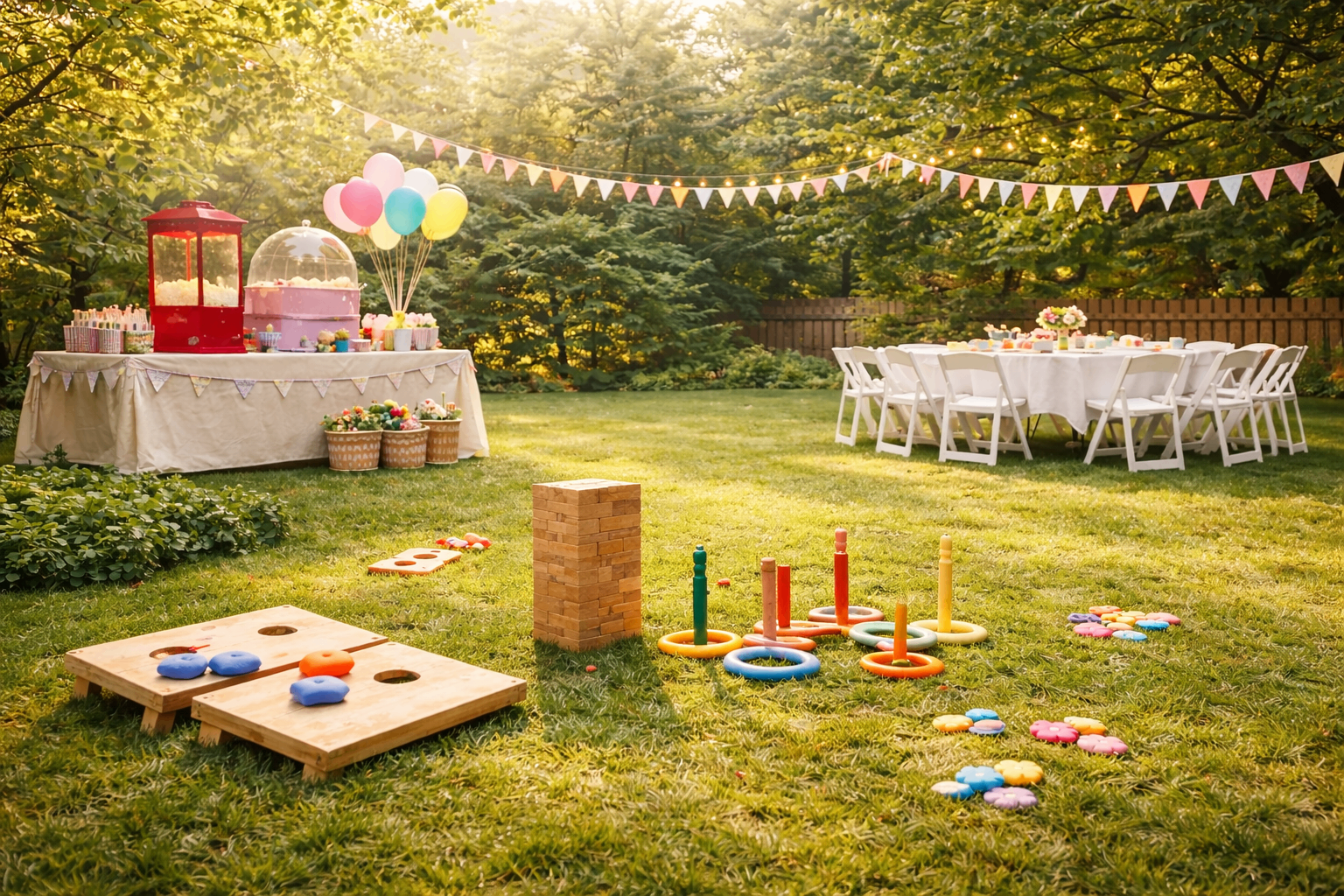
Backyard game rentals work perfectly for this. A giant Jenga tower or a cornhole setup becomes a home base that kids revisit between other activities. They play a round, wander off to do something else, then come back for another round later.
The anchor activity solves the "what do we do now" problem because there is always something available. Kids never feel like they are waiting for the next thing to happen.
Use Food as an Activity, Not Just a Meal
Most parties treat food as a pause in the action. Everyone stops playing, sits down to eat, and then tries to get the energy going again afterward.
But food can be one of the most engaging parts of the celebration if it is presented as an experience rather than a break.
A popcorn machine popping fresh kernels becomes a gathering spot where kids watch, wait, and chat. A cotton candy machine spinning colorful sugar becomes a mini event that kids line up for excitedly.
These food experiences work because they combine waiting (which builds anticipation) with watching (which holds attention) with a reward (which creates satisfaction).
Instead of a hard stop for lunch, treat stations can run throughout the party, giving kids a reason to circulate and stay engaged.
The Secret Role of Downtime
Parents often worry when they see kids sitting around and talking instead of actively playing a game.
But this is not disengagement. This is socializing.
Some of the most meaningful moments at a birthday party happen when kids are sitting together, sharing snacks, and talking about whatever seven year olds talk about when adults are not directing the conversation.
Providing comfortable spaces where kids can sit and rest, like tables and chairs set up in the shade, actually helps maintain engagement over the full length of the party.
Kids who are allowed to take breaks come back to activities with renewed energy. Kids who are pushed from one activity to the next without rest eventually burn out.
The best parties have a natural rhythm of active play and quiet socializing.
Reading the Room in Real Time
The most engaged parties are not the ones with the best plan. They are the ones where the host pays attention to what is happening and adjusts accordingly.
If a group of kids has abandoned the planned game and started inventing their own, that is a win. Let it happen.
If energy is dropping and kids look bored, that is the moment to reveal the treat station or bring out a new game.
If the birthday child is having a blast with just two friends in the corner of the yard, do not pull them away to do the next scheduled activity.
The host's job is not to run the party like a program director. It is to create an environment where fun happens naturally and then gently guide the energy when it needs a boost.
One More Thought
The parties where kids are most engaged are almost never the ones with the most activities.
They are the ones where the space felt inviting, the timing felt natural, and there was always something fun within reach.
Children do not need to be entertained every second. They need the freedom to play, a few well timed surprises, and an environment that makes them want to keep exploring.
When those elements come together, engagement is not something you have to manufacture.
It just happens.
If you are planning a party and want to create a setup that keeps kids naturally engaged, get in touch with us and we will help you build the right combination of games and activities for your group.
Katie
Explore our complete Three Sisters Hosting System for more tips on stress-free backyard hosting in the Capital Region.
See packages and pricing, try the party rental calculator, or check availability.