How Many Chairs Do You Need for a Graduation Party?
By Katie, Three Sisters Party Co. ·
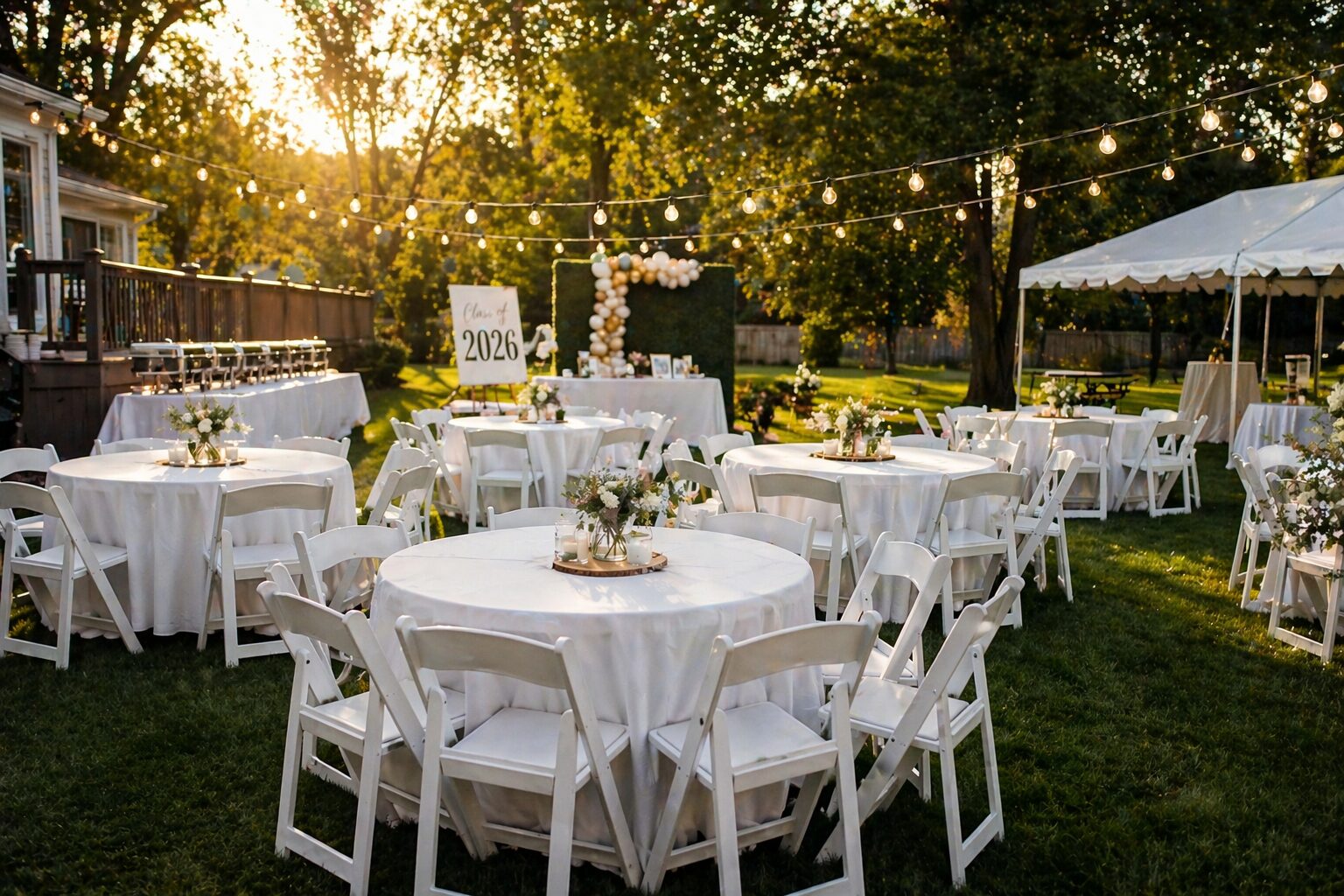
Quick Answer
For an open house graduation, plan seating for about 80 percent of your guest list. For sit down events with speeches or a meal, plan for 100 percent. Then design Conversation Pods of six to eight chairs around tables, never long rows along the edge of the yard.
1. Why Seating Is the Foundation of Every Party
When guests arrive at your home, they are not just looking for food. They are looking for comfort.
The first question every guest asks themselves, often subconsciously, is simple. Where do I land?
If the answer is clear, the guest relaxes immediately. If the answer is unclear, the guest enters what we call "hover mode." They stand near the food, they linger near the house, and they never fully settle into the event.
This is the beginning of the Seating Deficit.
Once guests start hovering, everything else begins to break down. Conversations stay short. Plates are held awkwardly. Guests leave earlier than expected. The party never quite reaches its full energy.
Seating is not a detail. It is the infrastructure that supports everything else.
2. The Two Types of Graduation Parties
Before you can calculate how many chairs you need, you need to understand the type of event you are hosting.
In the Capital Region, graduation parties generally fall into two categories.
The Open House Flow
This is the most common format in places like Latham, Niskayuna, and Saratoga Springs.
Guests arrive and leave over a three to five hour window. The flow is staggered, and not everyone is there at the same time. The energy is fluid, and the goal is to create movement and interaction.
The Sit Down Milestone
This format is more structured. There may be speeches, a formal meal, or a defined moment like a toast or slideshow. Guests arrive closer together and stay for a specific portion of the event.
The difference between these two formats is critical because it directly impacts your seating needs.
3. The Seating Formula That Actually Works
Most hosts assume they need one chair per guest. That is not always true.
At Three Sisters, we use two simple rules.
The 70 Percent Rule (Open House)
For an open house style event, you need seating for approximately 70 percent of your guest list.
Example: If you have 50 guests, you should plan for 35 chairs.
Why this works: Not everyone is sitting at the same time. Some guests are eating, some are talking, and some are moving through the yard. This creates a natural rotation of seats.
However, this only works if your layout supports movement, which we will get to shortly.
The 100 Percent Rule (Sit Down Events)
If your event includes a structured moment such as a speech or a coordinated meal, you need seating for 100 percent of your guests.
There is no flexibility here.
Guests should never be standing during a milestone moment. It breaks the experience and signals a lack of preparation.
4. The Hidden Variable: Peak Density
One of the biggest mistakes hosts make in Albany, Troy, and Clifton Park is planning for average attendance instead of peak attendance.
Your party may run for four hours, but there will be a one hour window where the majority of your guests are present at the same time.
This is your peak density.
If you under plan for this moment, the entire event feels crowded, even if it is technically correct over the full duration.
A 60 person guest list might feel like a 90 person party during that peak hour.
The Seating Standard is built around that peak, not the average.
5. Why Cheap Chairs Make the Problem Worse
Many families try to solve seating by borrowing chairs or buying inexpensive plastic options.
This creates what we call the Comfort Gap.
A guest sitting in a flimsy or unstable chair never fully relaxes. They remain physically tense, adjusting their posture, balancing on uneven grass, and subconsciously preparing to stand back up.
This leads to shorter conversations and quicker exits.
Our White Resin Chairs are designed to eliminate that problem.
They provide:
- stability on soft grass
- consistent height and spacing
- visual uniformity across the yard
When seating feels solid, guests stay longer. When guests stay longer, the event builds energy.
6. The Layout Matters More Than the Number
You can have the correct number of chairs and still fail if the layout is wrong.
The most common mistake we see is the "row layout." Chairs lined up in straight lines along the edge of a yard or deck.
This creates isolation, not connection.
Instead, we use what we call Conversation Pods.
Groups of six to eight chairs arranged around a central table.
This creates:
- natural conversation groups
- a sense of place for each guest
- clear zones across the yard
A well designed layout makes 40 chairs feel like 60. A poor layout makes 60 chairs feel like 30.
7. Real Example: The 50 Guest Graduation
Let's walk through a real scenario.
A family in Loudonville is hosting a 50 guest open house graduation party.
Using the Seating Standard:
- Guest count: 50
- Seating target: 40 chairs
We would recommend:
- 5 sets of 6 chairs (30 total)
- plus additional overflow or flexible seating zones
Then we structure the yard:
- 3 conversation pods in the main lawn
- 1 smaller cluster near the patio
- 1 transition area between food and seating
This creates flow, balance, and enough seating without overcrowding the space.
8. The Emotional Impact of Getting It Right
This is the part most people underestimate.
When seating is correct, the host feels it immediately.
Instead of managing the crowd, you move through the event. Instead of worrying about logistics, you engage in conversations. Instead of watching the clock, you enjoy the moment.
Guests stay longer. The energy builds naturally. The event feels effortless.
This is not because you worked harder. It is because the infrastructure did the work for you.
9. Quick Seating Guide
If you are planning right now, use this simple reference.
- 25 guests: 24 chairs
- 50 guests: 40 to 48 chairs
- 75 guests: 60 to 70 chairs
- 100 guests: 85 to 100 chairs
And always include a small buffer.
There is always one extra guest, one shifted chair, or one unexpected need.
10. Conclusion: Seating Is Not a Guess
The biggest shift we want you to make is this.
Stop guessing.
Seating is not about estimating. It is about designing.
When you apply the Seating Standard, you are not just ordering chairs. You are building the foundation of your event. You are giving your guests a place to land, a place to connect, and a reason to stay.
That is what turns a graduation party into a memory.
Saratoga Springs · Loudonville · Clifton Park · Bethlehem · Latham · Niskayuna · Albany · Troy
See packages and pricing, try the party rental calculator, or check availability.