First Birthday Party at Home: What You Actually Need and What You Can Skip
By Katie, Three Sisters Party Co. ·
Quick Answer
Plan a first birthday around your baby's nap schedule, keep it to about 90 minutes to two hours, seat the adults comfortably, keep food simple, and set up one photo and cake area. Skip organized games, elaborate favors, and a packed schedule. Tables, chairs, and concession rentals make hosting easier throughout the Capital Region.
A first birthday feels like a big deal because it is.
You made it through an entire year of bottles, naps, first foods, milestones, photos, doctor visits, sleepless nights, and days that somehow felt both incredibly long and incredibly fast.
So when that first birthday arrives, it is easy to feel like the party has to be big too.
It does not.
A one year old does not need a packed schedule, elaborate entertainment, six organized games, or decorations covering every room.
For most families, the easiest first birthday parties are the ones built around the baby's routine and the people who are actually coming to celebrate.
If you are hosting at home, focus on timing, comfortable seating, easy food, a simple cake area, and enough space for everyone to relax.
Here is what is actually worth planning and what you can probably skip.
Start With Your Baby's Schedule
The best party time is usually the time when your child is normally happiest.
If your baby typically naps from 12:30 to 2:30, a 1:00 birthday party may look convenient for everyone else but could make the entire afternoon harder.
A late morning party can work beautifully.
So can a mid afternoon party after a nap.
You know your child's schedule better than anyone else.
Use it.
Guests can adjust to a 10:30 AM party. Your one year old may not adjust nearly as well to missing the nap they rely on every day.
Keep the Party Short
A first birthday does not need to last four hours.
Around 90 minutes to two hours is plenty for many families.
That gives guests time to arrive, visit, eat, watch the birthday child have cake, take photos, and enjoy themselves without stretching the event until everyone is tired.
If close family stays longer, that is fine.
But having a clear end time on the invitation helps everyone understand the plan.
For example:
Saturday, 11:00 AM to 1:00 PM
or
Sunday, 2:30 PM to 4:30 PM
A shorter party is usually easier on both the baby and the host.
Decide Who the Party Is Really For
Is your guest list mostly grandparents, aunts, uncles, cousins, and family friends?
Or are you inviting a large group of babies and toddlers?
Those are two very different parties.
If most of your guests are adults, plan for adults.
That means enough seating, food they actually want to eat, drinks, coffee if appropriate, and comfortable places to talk.
You do not need to turn the backyard into a toddler amusement park because the guest of honor is turning one.
If several young children are coming, add a simple play space with age appropriate toys.
That is usually enough.
You Probably Need More Adult Seating Than Kid Seating
First birthday parties are often much more adult heavy than other children's birthdays.
If you are hosting 30 people and 24 of them are adults, plan your seating around those 24 adults.
Use what you already have first:
Dining chairs
Kitchen stools
Patio furniture
Benches
Outdoor seating
Then fill the gaps with folding chairs if needed.
You may not need a formal dining seat for every person if the food is casual.
But grandparents, older relatives, pregnant guests, and anyone staying for a couple of hours should have somewhere comfortable to sit.
One or Two Extra Tables Can Make a Huge Difference
A first birthday creates a surprising amount of stuff.
Cake.
Food.
Drinks.
Gifts.
Napkins.
Plates.
Serving utensils.
Decorations.
Your dining table can fill up very quickly.
One extra six foot table can become a food table, gift table, dessert station, or drink station.
Two extra tables can completely change the flow of a room or backyard.
Before adding tables, give each one a job.
If you cannot say what a table will be used for, you probably do not need it.
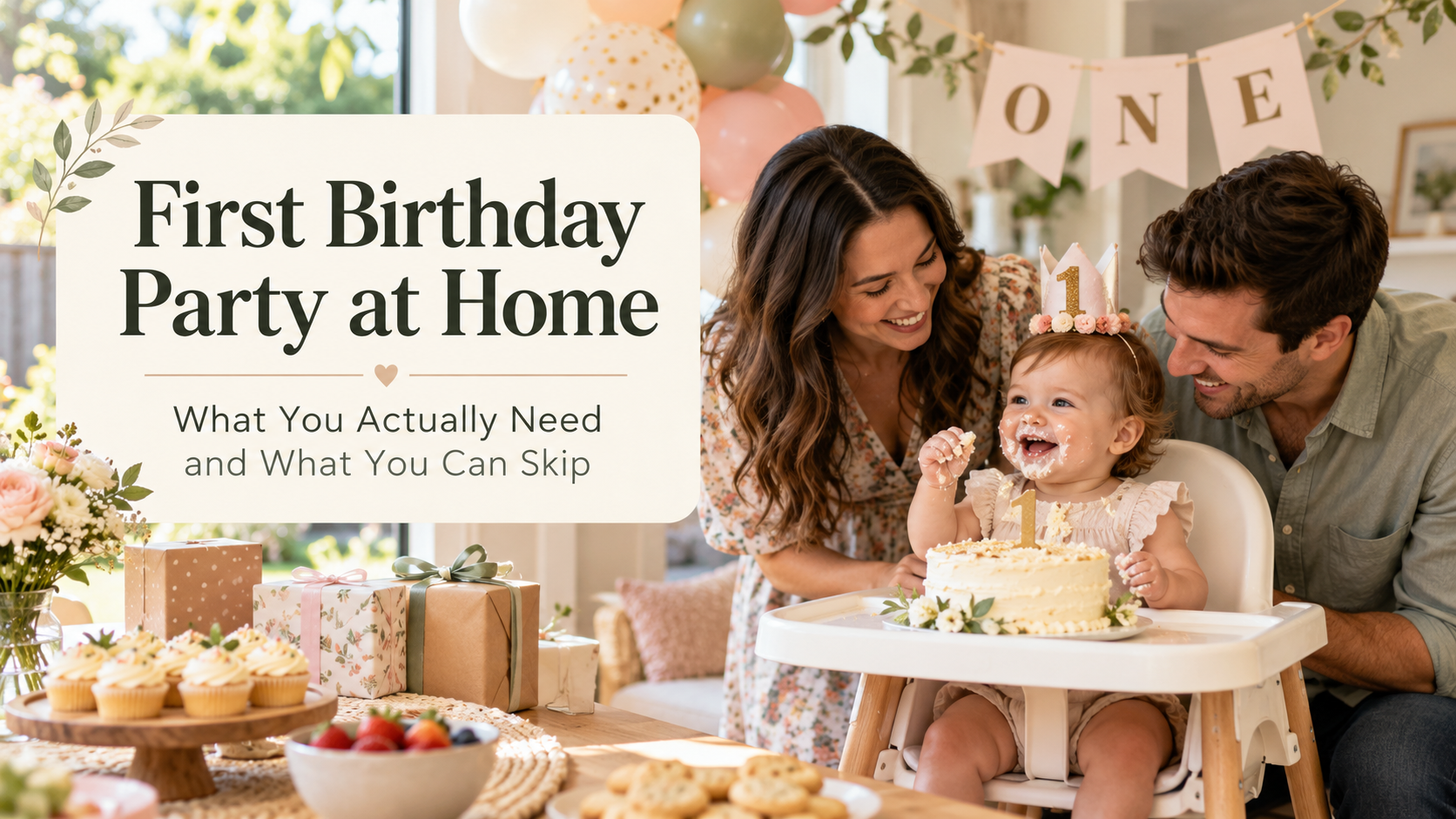
Create One Main Photo and Cake Area
You do not need decorations everywhere.
Choose one area that will be in most of the pictures.
That could be:
Behind the high chair
Against a simple wall
On the patio
Beside a birthday banner
In front of a small balloon display
Put your decorating effort there.
The photos people usually care about most are the birthday child with cake, family pictures, grandparent pictures, and a few overall party photos.
One intentional focal point can make those pictures feel special without decorating your entire house.
The High Chair Matters More Than a Kids Table
For a first birthday, the high chair usually becomes the center of the cake moment.
Make sure it is clean, stable, and positioned somewhere that photographs well.
Think about the background before the party starts.
A simple wall or decorated area will usually look better than a cluttered kitchen counter.
You can add a small banner or high chair decoration, but keep the setup practical and safe.
You probably do not need a separate children's table unless several older siblings, cousins, or preschoolers are attending.
Keep the Food Easy
A first birthday is not the best time to choose a menu that requires you to cook throughout the party.
Pick food you can prepare ahead, order, or serve easily.
Depending on the time of day, that might include:
Pizza
Sandwiches
Wraps
Bagels and brunch foods
Baked pasta
Salads
Fruit
Snack trays
Simple appetizers
If your party falls directly over lunch or dinner, guests will reasonably expect more substantial food.
If the party is from 2:30 to 4:30, snacks, cake, and drinks may be enough.
Match the food to the time instead of trying to serve a full meal simply because it is a birthday.
Put Drinks Somewhere Separate
This is one of the easiest ways to improve party flow.
Guests return for drinks more often than they return for food.
If the cooler, coffee, water, juice, cups, and buffet are all on one table, that area gets crowded quickly.
Set up a separate drink station if you have room.
For a morning or brunch party, coffee can be especially appreciated by adults.
For an afternoon event, water, juice, sparkling water, and other simple drinks may be plenty.
The goal is to let people help themselves without creating another job for you.
You Do Not Need a Full Schedule of Games
One year olds are not waiting for organized birthday games.
If other babies or toddlers are attending, a play mat or blanket with a few toys can be enough.
Bubbles can be fun.
Balls can be fun.
Simple push toys can be fun.
If older siblings or cousins are coming, give them something appropriate to do too.
That might mean backyard games, coloring, a movie, or a play area.
You do not need to schedule every 15 minutes.
Adults talking while children play is a perfectly successful first birthday.
You Can Skip Opening Every Present
Gift opening can take a long time.
A one year old may be fascinated by wrapping paper for five minutes and then lose interest completely.
If opening gifts during the party is important to your family, absolutely do it.
But it is not required.
For a larger gathering, opening gifts afterward can keep the party shorter and give your child more time to interact with the people who came to celebrate.
Do Not Overcomplicate the Smash Cake
The cake moment is memorable because of the baby, not because the cake cost a fortune.
A small cake, cupcake, or simple smash cake is enough.
Have wipes nearby.
Have a change of clothes ready.
Put a towel or washable mat underneath the high chair if that will make cleanup easier.
Take the photos.
Let the baby enjoy the cake.
Then move on.
It does not need to become a production.
Have a Place for Coats, Diaper Bags, and Baby Gear
If several families with young children are attending, your entryway can fill quickly.
Diaper bags, strollers, coats, carriers, shoes, bottles, and blankets all need somewhere to go.
Choose a spot beforehand.
A spare bedroom, mudroom, hallway, garage, or designated corner can work.
Keeping that gear away from the main gathering space gives everyone more room.
Keep One Quiet Space Available
A first birthday can be a lot for a one year old.
New faces.
Noise.
Music.
People wanting to hold them.
Cake.
Photos.
If your child becomes overwhelmed, it helps to have one normal, quiet room available.
Maybe that is the nursery.
Maybe it is your bedroom.
Do not turn every room into party space.
Having somewhere to take the baby for ten quiet minutes can make the rest of the party much easier.
Think About Grandparents and Older Guests
First birthdays often bring several generations together.
Make sure older relatives have comfortable, stable seating.
Avoid making every available seat a low outdoor chair or picnic blanket.
If the party is outside, give older guests access to shade or shelter when needed.
Try to place some seating where guests do not need to cross wet grass or navigate unnecessary steps.
Comfort matters more than having a perfectly styled setup.
What Can You Skip?
You can skip anything that creates a lot of work without making the day better.
That may include:
Elaborate party favors
Multiple organized games
A huge dessert table
Decorating every room
A complicated theme
Formal place settings
Entertainment your baby does not understand
Opening every gift during the party
An oversized guest list you do not actually want
If you genuinely enjoy those things, include them.
They just are not required for a good first birthday.
What Is Actually Worth Having?
For most first birthdays at home, focus on:
Enough comfortable seating
A few useful tables
Easy food
Drinks
Cake
A high chair
A simple photo area
A safe place for children to play
A place for coats and bags
Trash and cleanup supplies
A weather backup if part of the party is outside
That is the foundation.
Everything else is optional.
Frequently Asked Questions
How long should a first birthday party last?
Around 90 minutes to two hours works well for many families. Your child's nap schedule and temperament should matter more than following a standard party length.
What time is best for a first birthday party?
Choose a time when your child is normally awake, fed, and happy. Late morning or mid afternoon often works well depending on naps.
Do I need games at a first birthday?
No. If young children are attending, simple toys and free play are usually enough. Organized games are optional.
How many chairs do I need?
Plan around the number of adults and older guests who will realistically want to sit at the same time.
Do I need a kids table?
Usually not for the birthday child. A children's table may be useful if several preschool or school age siblings and cousins are attending.
Should we open presents during the party?
Only if you want to. Opening gifts afterward can make a larger party easier and shorter for the birthday child.
Your One Year Old Does Not Need a Perfect Party
The first birthday matters.
But it matters because of the milestone, not because every detail looks like a magazine.
Your child will not remember whether the napkins matched the balloons.
You will remember who came.
You will remember grandparents holding the baby.
You will remember the cake everywhere.
You will remember the photos.
And you will probably remember how strange it felt that an entire year had already passed.
Plan around your child.
Give your guests somewhere comfortable to sit.
Serve food that is easy to manage.
Choose one spot for the photos.
Keep the party short enough that everyone can enjoy it.
Then let the rest be simple.
Three Sisters Party Co. provides tables, chairs, concession machines, backyard games, coffee urns, food warming mats, and other party rentals for first birthdays and family celebrations throughout Albany and the surrounding Capital Region.
Planning a first birthday at home? Use our Party Rental Calculator to estimate tables and chairs, or Check Availability with your event date and full address.
First birthday parties at home work best when built around the baby's routine. Late morning or mid afternoon timing, about 90 minutes to two hours, comfortable seating for adults, easy food, one cake and photo area, and a short guest list matter most. Organized games, elaborate favors, and opening every present can all be skipped.
See packages and pricing, try the party rental calculator, or check availability.