How Many Backyard Games Do You Need for 25, 50, or 100 Guests?
By Katie, Three Sisters Party Co. ·
Quick Answer
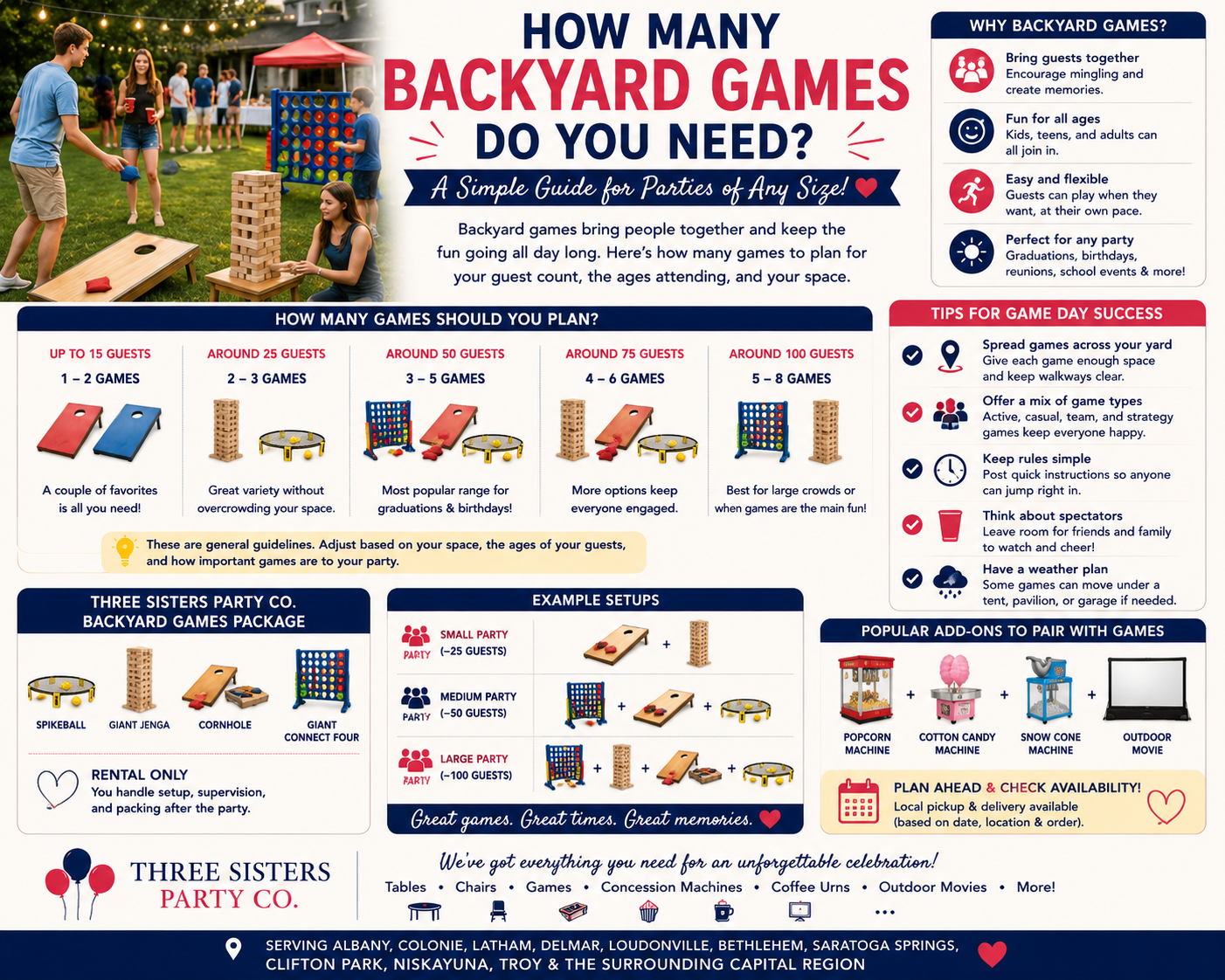
Plan approximately one active game station for every 10 to 15 guests when games are a main activity. For 25 guests, choose 2 to 3 games. For 50 guests, plan 3 to 5 games. For 75 to 100 guests, plan 4 to 8 stations depending on whether games are the focus or one of several activities.
Backyard games can make a graduation party, birthday celebration, family reunion, school event, or neighborhood gathering feel more relaxed and interactive.
They give children something to do between food and cake, help teenagers move away from their phones, and give adults an easy way to join the fun without committing to a scheduled activity.
The question is not usually whether guests will enjoy the games.
The more difficult question is:
How many backyard games do you actually need?
A practical starting point is approximately one active game station for every 10 to 15 guests when games are an important part of the celebration. Fewer stations may be enough when games are simply optional background entertainment. Current rental guidance varies slightly, with recommendations ranging from one game for every 8 to 10 guests to approximately three to five games for groups of 40 to 60 people.
For most casual parties, you do not need a game for every guest. You need enough variety to prevent one long line, provide options for different ages, and keep the activities spread throughout the yard.
For families hosting events throughout Albany, Loudonville, Latham, Colonie, Delmar, Bethlehem, Saratoga Springs, Clifton Park, Niskayuna, Troy, and the surrounding Capital Region, this guide explains how many games to plan for 25, 50, 75, or 100 guests and how to make a smaller collection work for a larger crowd.
1. Decide Whether Games Are the Main Entertainment
The correct number of games depends on the role they will play during the party.
At one event, backyard games may be the main attraction. Guests arrive expecting to play cornhole, Spikeball, Giant Jenga, and Giant Connect Four throughout the afternoon.
At another event, the games may simply provide something optional to do while guests eat, talk, visit the concession station, or watch an outdoor movie.
When games are the primary entertainment, plan more active stations and enough open space for guests to rotate without waiting.
When they are one part of a larger party, fewer games may be completely sufficient.
A graduation open house with food, desserts, a snow cone machine, music, and several seating areas does not need every guest playing a game at the same time.
2. Plan Two or Three Games for 25 Guests
For approximately 25 guests, two or three backyard games will usually provide enough variety.
This works especially well when the group includes a mix of adults and children. One game can appeal to guests who want a casual activity, while another can create more energy.
For example, cornhole gives adults and older relatives a familiar game they can play while talking. Giant Connect Four provides short rounds that children can understand quickly. Spikeball creates a more active option for teenagers or energetic adults.
Three games are helpful when the guest list includes several age groups or when games are the main entertainment.
Two games may be enough when the party also includes a concession machine, meal, crafts, swimming pool, movie, or another planned activity.
The goal is to provide a choice without spreading a small group across too many separate stations.
3. Plan Three to Five Games for 50 Guests
For approximately 50 guests, three to five game stations provide a useful planning range.
Current event-rental guidance commonly recommends roughly three to five games for gatherings of 40 to 60 people.
Four different games are often a strong middle ground.
They provide enough variety for active players, casual players, children, adults, and spectators without covering the entire yard with equipment.
Three Sisters Party Co.'s Backyard Games Package includes Spikeball, Giant Jenga, cornhole with bean bags, and Giant Connect Four. The package is rental only. Customers are responsible for setting them up, supervising their use, collecting all pieces, and packing them for return or pickup.
For a 50 person open house, those four games can work especially well because not every guest will be present or playing at the same time.
Place the games in separate areas rather than grouping all four beside one another. This distributes guests across the property and makes each station easier to use.
4. Plan Five or Six Games for 75 Guests When Play Is Central
A 75 person celebration may need five or six stations when backyard games are the primary entertainment.
However, a smaller collection can still work when the games are one part of a larger event.
For example, a graduation party with 75 total guests may also include a buffet, dessert station, seating areas, music, a snow cone machine, and family members arriving at different times.
In that situation, four games can provide plenty of optional entertainment.
If all 75 guests arrive during the same period and games are expected to keep a large group actively occupied, additional stations, duplicate games, or another structured activity may be helpful.
Another option is combining the Backyard Games Package with a separate activity such as a Nerf Battle, concession station, or outdoor movie. This creates several destinations around the property rather than expecting four games to entertain the entire crowd continuously.
5. Plan Six to Eight Stations for 100 Guests When Games Are the Focus
For an event with approximately 100 guests, six to eight stations may be appropriate when games are the main attraction. Current planning guidance for larger gatherings often recommends five to eight games for crowds of 75 or more.
That does not mean every 100 person party requires eight rentals.
A large graduation open house may have only 30 or 40 guests present at one time. Many guests will be eating, talking, taking pictures, or visiting another activity.
A four game package can still work as background entertainment for a 100 person open house when attendance is staggered.
For a school field day, company picnic, or event where nearly everyone arrives together and expects organized recreation, four games alone may create waiting.
In that situation, consider additional activity areas, timed rotations, team competitions, or several different entertainment categories.
6. Count Active Player Spaces, Not Just Equipment
Two game stations do not always provide the same capacity.
Giant Connect Four may have two people actively playing while others watch and wait for a short round to finish.
Spikeball typically involves a small active group and requires more movement.
Cornhole can be played individually or in teams, and the next players can rotate in after each round.
Giant Jenga may involve one active player at a time, but an entire group can gather around the tower and participate in the suspense.
This means the best game collection includes different styles.
A package with four games that all require only one slow player at a time may create more waiting than four games with quick rounds and team participation.
Three Sisters Party Co.'s package provides a useful mix of active, strategic, familiar, and spectator-friendly games.
7. Match the Games to the Guest Ages
The same four games may work differently depending on who is attending.
For a party with young children, simple rules and shorter turns are important. Giant Connect Four is easy to understand, while cornhole can be moved closer to make the throws more manageable.
For teenagers, Spikeball may become the most active station. Giant Jenga can also attract a crowd when the tower begins to grow.
Adults and older relatives may prefer cornhole or Connect Four because the games allow conversation and do not require constant running.
A multigenerational party benefits from having both high energy and low energy options.
Do not choose every activity for the youngest or most athletic guests. The best setup gives several parts of the guest list a comfortable way to participate.
8. Consider How Long the Party Will Last
A two hour birthday party and a six hour graduation open house do not need the same activity plan.
During a shorter event, guests may play only one or two rounds before moving to food, cake, or another scheduled activity.
During a long open house, guests may return to the games several times.
A longer event benefits from more variety because the same activity can become less interesting after several hours.
However, staggered attendance can reduce crowding. Even when 75 or 100 people attend throughout the day, the number present during one hour may be much smaller.
Think about peak attendance rather than the total guest list alone.
Ask yourself when the largest number of guests will be present and how many are likely to want to play at that moment.
9. Give Each Game Enough Space
Ordering enough games is only helpful when the yard has enough usable space.
Cornhole requires a long, clear lane. It can work well along a driveway or an open side of the yard.
Spikeball needs room for players to move around the net without running into furniture, landscaping, or other guests.
Giant Jenga needs a flat and stable surface. A patio or level section of lawn is usually better than a slope.
Giant Connect Four needs less active space but should still be positioned where players and spectators will not block an important walkway.
Do not place four games tightly inside one small corner simply because that section is away from the food.
A safe three game setup is better than an overcrowded five game setup.
10. Spread the Games Across the Yard
Games work best when they create several separate activity areas.
Place an active game such as Spikeball in the most open section of the lawn. Keep cornhole along a long edge where missed bags will not land near food or seated guests.
Giant Jenga can sit near a conversation area where spectators can watch without standing in the main walkway. Giant Connect Four can work near a shaded seating area or covered patio.
Spreading out the stations reduces crowding and encourages guests to use more of the yard.
It also helps prevent one large group from forming directly beside the buffet, drink station, or house entrance.
The games should support the party layout rather than interrupt it.
11. Do Not Place Games Too Close to the Tables
Guests need clear space to sit, carry food, and move between the tables.
A cornhole lane should not run through the main seating aisle. Spikeball players should not be moving directly behind occupied chairs.
Giant Jenga should be far enough from dining tables that falling blocks will not hit guests, drinks, decorations, or serving dishes.
Leave a visible separation between the seating and activity areas.
This makes the games easier to play and helps guests who prefer to sit and talk enjoy the party without becoming part of an active game zone.
The separation does not need to be enormous. It only needs to create clear expectations about where play occurs and where guests walk.
12. Use a Tournament to Make Four Games Serve More Guests
A simple tournament can make a smaller game collection more engaging for a larger crowd.
You do not need a complicated bracket or professional scoring system.
Create short rounds, write team names on a poster, and allow winners to continue or move to the next station.
For cornhole, teams can play to a shorter point total so each round moves quickly.
Giant Connect Four can use a best of three format.
Spikeball teams can play shorter games during the early rounds.
Giant Jenga may work better as an open challenge than a formal head to head tournament. Record the tallest completed tower or longest successful round.
A tournament gives guests a reason to rotate instead of staying at one station all afternoon.
13. Keep the Rules Easy to Find
Many games appear simple, but not every guest knows how to play.
Place a short rule card near each station or explain the games to several adults before the party begins.
The instructions should answer the most important questions: how many people play, where they stand, how the round begins, and how someone wins.
Avoid creating complicated house rules that require a long explanation.
The easier the game is to start, the more likely guests are to use it without asking the host for help.
For school events or larger celebrations, assign one volunteer to the activity area during the busiest period.
14. Plan for Spectators
A game station often attracts more people than the number actively playing.
Giant Jenga is a good example. Two people may be taking turns, but six or eight others may gather around to watch the tower fall.
Leave room for spectators without allowing them to block the next game station or a main walkway.
A few separate chairs near the lower energy games can help older relatives watch and participate socially.
Do not place spectator seating inside the cornhole throwing lane or the movement area surrounding Spikeball.
The people watching are part of the activity plan, even when they are not counted as active players.
15. Keep Food and Drinks Away From the Equipment
Guests may carry drinks while playing cornhole or standing near Giant Connect Four.
Create a nearby place where they can set cups safely.
Do not encourage guests to place drinks on wooden game pieces or directly beside the Giant Jenga tower.
Food, syrup, grease, and moisture can damage rental equipment or make the pieces slippery.
Keep concession machines and the main buffet in their own zones.
After the party, check the grass around every game for cups, napkins, plates, and personal belongings before packing the equipment.
16. Have a Weather Backup
Backyard games depend on the surface and weather.
A brief shower may leave the lawn too slippery for Spikeball or make the Giant Jenga area unstable.
Some games can be moved into a garage, pavilion, or indoor room when enough space is available. Giant Connect Four and Giant Jenga may be easier to relocate than cornhole or Spikeball.
Do not place wooden games on wet grass or leave them outside overnight.
If rain is expected, prepare a smaller protected game area and decide which activities can move inside safely.
Not every outdoor game must continue during poor weather. Protecting the equipment and guests should come before keeping every station open.
17. Use This Guest-Count Guide as a Starting Point
The following chart provides a practical planning range:
| Expected guests | Suggested game stations |
|---|---|
| Up to 15 guests | 1 to 2 games |
| Approximately 25 guests | 2 to 3 games |
| Approximately 50 guests | 3 to 5 games |
| Approximately 75 guests | 4 to 6 games |
| Approximately 100 guests | 5 to 8 games |
Use the lower end when games are optional and several other activities are available.
Use the higher end when games are the primary entertainment and most guests will attend at the same time.
The type of games, usable yard space, and number of active player positions are just as important as the guest count.
18. Understand What Three Sisters Party Co. Provides
Three Sisters Party Co.'s Backyard Games Package includes Spikeball, Giant Jenga, cornhole with bean bags, and Giant Connect Four.
The games are rental only. Customers are responsible for setting them up, supervising their use, collecting all pieces, and packing them for return or pickup.
Adult supervision is important, especially when young children are playing near the Giant Jenga tower, cornhole boards, or active Spikeball area.
Pickup is available, and local delivery may be available depending on the event date, address, requested rentals, order size, and schedule.
When checking availability, provide the event date, full address, approximate guest count, age range, and whether the games will be the main activity or one part of the celebration.
Frequently Asked Questions
How many backyard games do I need for 25 guests?
Two or three games are usually enough. Choose a mix of active and casual games so guests have more than one way to participate.
How many games do I need for 50 guests?
Three to five stations provide a practical range. The four game Three Sisters Party Co. package works especially well for an open house party where not every guest plays at once.
How many games do I need for 100 guests?
Plan approximately five to eight stations when games are the main entertainment. Fewer may work when attendance is staggered and the event also includes food, concessions, music, or other activities.
Is one game for every 10 guests a good rule?
It is a useful starting point, but the exact number depends on how many people can play each game, how long rounds take, and how important the games are to the event.
Do all guests need to be able to play at once?
No. Most parties have guests eating, talking, watching, or using other activities at the same time. Plan enough capacity to prevent long waits, not enough equipment for every guest to play simultaneously.
What games work best for mixed ages?
A mix such as cornhole, Giant Connect Four, Giant Jenga, and Spikeball provides both low energy and high energy choices for different ages.
How much space do backyard games need?
Each game is different. Cornhole needs a long lane, Spikeball needs open movement space, Giant Jenga needs a flat surface, and Giant Connect Four needs room for players and spectators.
Can the games be used indoors?
Some games may work indoors when the room has enough space and the property owner permits them. Confirm that floors, walls, ceilings, and nearby furniture will remain protected.
Are the games set up for us?
No. The backyard games are rental only. Customers handle setup, supervision, collection, and packing unless another arrangement has been specifically confirmed.
Are all game pieces included?
The package includes the accessories required for the listed games. Customers should count and collect all pieces before packing the rentals.
Provide Variety Without Overcrowding the Yard
The right number of backyard games depends on more than the total guest count.
For approximately 25 guests, two or three games will often be enough. For 50 guests, three to five provides a practical range. Larger parties may need additional stations when games are the main entertainment.
You do not need one game for every person.
Choose a mix of active and casual options, spread the stations throughout the yard, leave room for spectators, and keep the games away from food and busy walkways.
Three Sisters Party Co. provides backyard games, tables, chairs, concession machines, Nerf Battle equipment, outdoor movie rentals, and party add-ons for graduations, birthdays, school events, family reunions, and backyard celebrations throughout Albany, Colonie, Loudonville, Latham, Delmar, Bethlehem, Saratoga Springs, Clifton Park, Niskayuna, Troy, and the surrounding Capital Region.
View our packages and pricing, use the Party Rental Calculator, or check availability for your event date and address.
25, 50, 75, or 100 guests
See packages and pricing, try the party rental calculator, or check availability.