How Many Plates, Cups, Napkins, and Forks Do You Need for a Party?
By Katie, Three Sisters Party Co. ·
Quick Answer
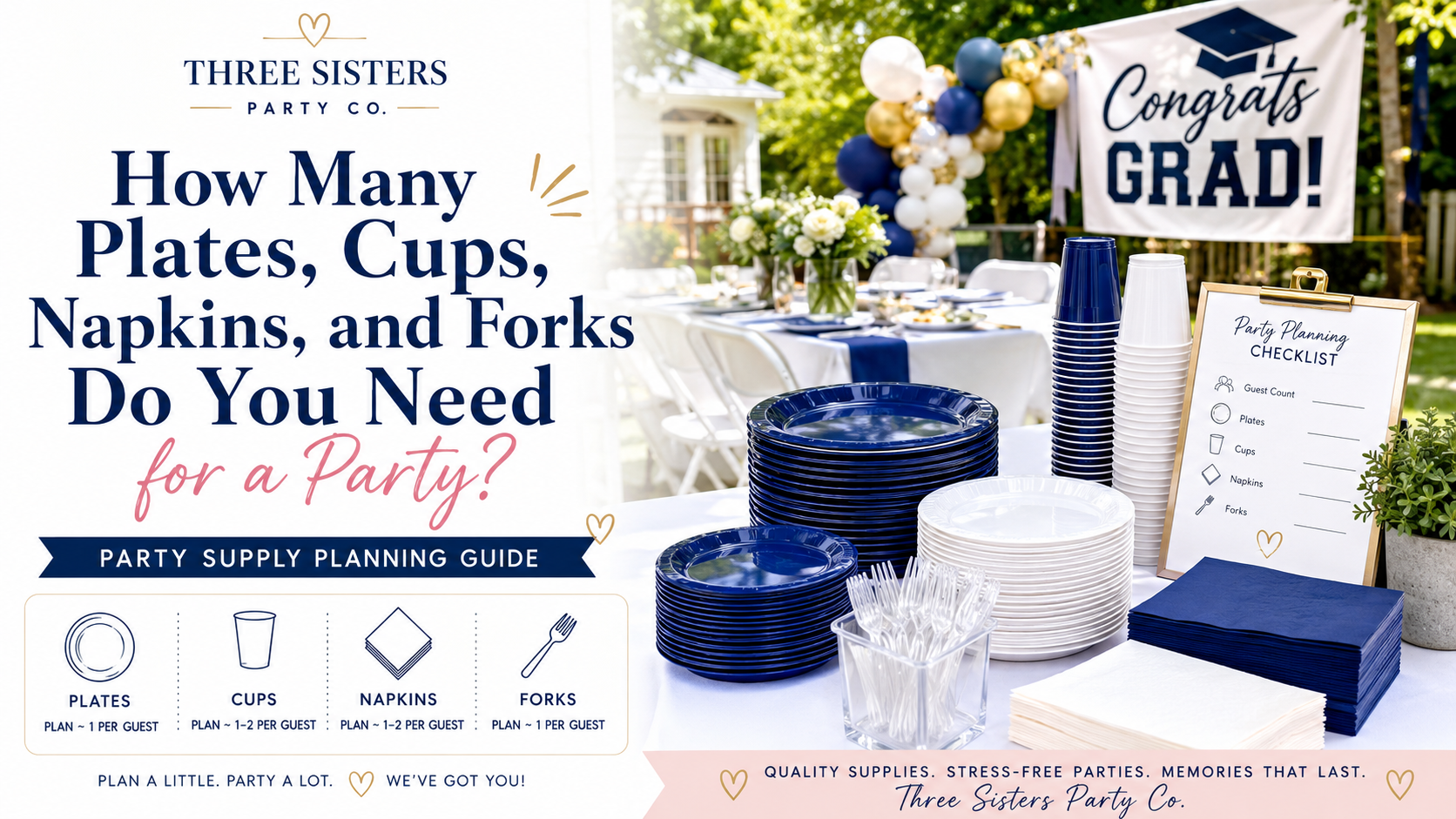
Plan approximately 10 to 20 percent extra dinner plates and utensils, two to three cups per guest, and three napkins per guest. Adjust based on menu, party length, guest ages, and whether dessert requires separate plates and forks.
Planning the tables, chairs, food, and activities for a party usually receives most of the attention.
Then the event gets closer, and the host realizes there is another entire category that still needs to be purchased:
Plates, cups, napkins, and utensils.
These supplies may seem simple, but estimating them can be surprisingly difficult. Buying exactly one of everything for each guest leaves no room for dropped forks, misplaced cups, second helpings, dessert, or unexpected visitors.
Buying several times the guest count can create unnecessary expense and leave the host storing unopened party supplies for years.
So how many disposable plates, cups, napkins, and forks do you actually need?
For most casual backyard parties, a practical starting point is to plan approximately 10 to 20 percent extra plates and utensils, two to three cups per guest, and three napkins per guest.
The final amount depends on the menu, party length, guest ages, beverage setup, and whether the same plates and utensils can be used for both the meal and dessert.
For families hosting graduation parties, birthday celebrations, family reunions, school events, showers, and backyard gatherings throughout Albany, Loudonville, Latham, Colonie, Delmar, Bethlehem, Saratoga Springs, Clifton Park, Niskayuna, Troy, and the surrounding Capital Region, this guide provides practical quantities for events with 50, 75, or 100 guests.
1. Do Not Purchase Exactly One of Everything Per Guest
A party with 50 guests needs more than exactly 50 plates, 50 cups, 50 napkins, and 50 forks.
Someone may drop a plate while moving through the buffet. A child may use a clean fork for dessert after losing the first one in the grass. A guest may forget which cup belongs to them and take another.
There may also be a few last-minute guests who were not included in the original count.
You do not need to double every supply, but you should include a reasonable buffer.
For dinner plates and utensils, planning approximately 10 to 20 percent extra works well for many casual events.
That means a party with 50 guests should generally have approximately 55 to 60 dinner plates rather than exactly 50.
The buffer provides flexibility without creating excessive waste.
2. Plan Dinner Plates Based on the Type of Meal
For a buffet-style meal, begin with one dinner plate per guest and add approximately 10 to 20 percent extra.
A practical guide looks like this:
| Expected guests | Recommended dinner plates |
|---|---|
| 25 guests | 30 plates |
| 50 guests | 55 to 60 plates |
| 75 guests | 85 to 90 plates |
| 100 guests | 110 to 120 plates |
The higher number is helpful when guests may return for second helpings with a clean plate.
The lower number may be enough when the meal is simple, the guest count is firm, and the host will replenish the buffet in smaller stages.
For food safety and general cleanliness, guests should not be encouraged to return to a self-service buffet with a plate they have already used.
Providing a small quantity of extra plates makes it easier for everyone to take a fresh one.
3. Use Sturdy Plates for a Full Meal
Plate quality matters just as much as plate quantity.
A thin paper plate may work for cake, cookies, or light snacks. It may not work well for pasta, meatballs, baked beans, salads, or foods with sauces.
Guests should not need to use two or three plates simply to keep the food from bending or leaking.
For a complete meal, choose sturdy dinner-sized plates designed to hold hot and heavier foods.
This may cost slightly more per plate, but it can reduce the number guests use and prevent spills around the seating area.
Test one plate before purchasing the full quantity. Place a realistic serving of party food on it and carry it across the room.
If the plate bends significantly while empty or lightly loaded, it may not be the best option for the main meal.
4. Purchase Separate Dessert Plates When Needed
Cake and dessert often arrive after dinner plates have already been discarded.
If you are serving cake, cupcakes, pie, cookies, or another separate dessert course, plan approximately one dessert plate per guest plus a small buffer.
For 50 guests, approximately 55 dessert plates is usually enough.
For 75 guests, plan approximately 80 to 85.
For 100 guests, approximately 110 dessert plates provides a reasonable cushion.
You may not need a dessert plate for every guest when cupcakes or cookies can be handed out with a napkin. However, cake, pie, ice cream, and desserts with sauces usually need their own plates.
Do not assume guests will save their dinner plates for dessert during a long open-house celebration.
5. Cups Disappear Faster Than Plates
Disposable cups are often the supply that hosts underestimate most.
Guests set them on tables, leave them near the games, forget which one belongs to them, or take a new cup when switching from water to lemonade.
For a shorter birthday party or casual gathering, planning two cups per guest may be enough.
For a longer graduation open house, family reunion, or event with several drink options, two to three cups per guest is a safer estimate.
A practical estimate is:
| Expected guests | Recommended cups |
|---|---|
| 25 guests | 50 to 75 cups |
| 50 guests | 100 to 150 cups |
| 75 guests | 150 to 225 cups |
| 100 guests | 200 to 300 cups |
For most backyard parties, using the middle of the range provides a comfortable starting point.
That would mean approximately 125 cups for 50 guests, 190 cups for 75 guests, and 250 cups for 100 guests.
6. Cup Size Changes the Final Quantity
A 9-ounce cold cup and a 16-ounce party cup do not serve the same purpose.
Smaller cups may lead to more refills but can reduce wasted drinks. Larger cups hold more but may be set down half full and replaced later.
For water, lemonade, iced tea, or soda, cups in the 12- to 16-ounce range are common for casual parties.
For coffee, use smaller heat-safe cups that are designed for hot beverages. Do not use ordinary cold plastic cups with a coffee urn.
If you are providing snow cones, use the cups or cones designed for the machine rather than including them in the general beverage-cup estimate.
The same applies to popcorn bags and cotton candy cones. Those serving supplies should be calculated separately from standard plates and cups.
7. Labeling Cups Can Reduce Waste
One of the easiest ways to reduce cup use is helping guests identify their drinks.
Place permanent markers near the drink station and encourage guests to write their names on their cups.
You can also use reusable cup labels, different-colored cups, or small stickers.
This is especially useful at children's birthday parties and family reunions where several guests may have identical drinks.
Cup labeling will not eliminate the need for extras, but it may move your estimate closer to two cups per guest instead of three.
Keep the markers away from the food and place them where guests can use them before filling their cups.
8. Plan More Napkins Than You Think You Need
Napkins are used for more than wiping hands during the meal.
Guests use them with drinks, appetizers, desserts, concession machines, spills, children's snacks, and sticky foods.
For a casual party serving a complete meal, planning approximately three napkins per guest is a practical starting point.
A party with messy food, appetizers, desserts, or concession machines may need four or more per guest.
For a typical backyard party, use this estimate:
| Expected guests | Recommended total napkins |
|---|---|
| 25 guests | 75 to 100 napkins |
| 50 guests | 150 to 200 napkins |
| 75 guests | 225 to 300 napkins |
| 100 guests | 300 to 400 napkins |
Choose the higher end when serving barbecue, chicken wings, snow cones, cotton candy, or other messy foods.
9. Use Different Napkins for Different Stations
You do not need to place every napkin in one large stack beside the dinner plates.
Distribute them throughout the event.
Place full-sized luncheon or dinner napkins near the buffet. Smaller beverage napkins can go near the drink and coffee stations. Keep additional napkins beside the dessert and concession areas.
This prevents guests from walking back to the main food table every time they need one.
It also makes it easier to monitor which area is using supplies most quickly.
Personalized napkins can be used as part of the presentation, but consider purchasing less expensive coordinating napkins as the backup supply.
Guests will appreciate having enough more than they will notice whether every napkin has the graduate's name printed on it.
10. Plan One Fork Per Guest Plus Extras
For the main meal, plan one fork per guest plus approximately 10 to 20 percent extra.
The quantities should generally match the dinner-plate count.
For 50 guests, purchase approximately 55 to 60 dinner forks.
For 75 guests, approximately 85 to 90 forks is a practical amount.
For 100 guests, plan approximately 110 to 120.
Disposable forks are easy to drop, misplace, or accidentally throw away before dessert. Extras also help when a guest uses one utensil to serve food instead of using the designated serving piece.
Keep serving utensils visually separate from the disposable utensils so guests do not accidentally take them.
11. Dessert May Require a Second Set of Forks
If cake or dessert will be served after the meal, decide whether guests will realistically keep their original forks.
At a formal seated dinner, a dessert fork may already be included in the place setting.
At a casual backyard party, most meal forks will be thrown away before the cake is cut.
For cake, pie, or another dessert that requires utensils, plan a separate dessert fork for each expected guest plus approximately 10 percent extra.
This can nearly double the fork requirement.
A party with 50 guests may need 60 dinner forks and another 55 dessert forks.
When serving cupcakes, cookies, brownies, or handheld desserts, separate dessert forks may not be necessary.
Match the utensils to what guests will actually eat rather than purchasing a complete place setting for every possible item.
12. Purchase Spoons and Knives When the Menu Requires Them
Not every party needs equal quantities of forks, knives, and spoons.
A buffet serving pulled pork, baked ziti, salad, and cake may use mostly forks.
Knives may be necessary when serving foods that guests need to cut, such as meat, certain sandwiches, or firm entrées.
Spoons may be needed for soup, chili, ice cream, oatmeal, yogurt, or desserts served in cups.
Before purchasing a large combination pack, review the menu.
Combination utensil packages may appear economical but can leave the host with hundreds of unused spoons and not enough forks.
Buying the needed utensils separately may be more practical.
13. Open-House Parties Still Need Supplies for the Full Guest Count
A graduation open house may only have part of the guest list present at one time.
That can reduce the number of chairs needed, but it does not necessarily reduce the total number of plates, cups, napkins, and utensils.
Guests who arrive at different times will still eat and drink during the event.
For example, a 100-person open house may only need seating for 70 or 80 people at one time, but it still needs supplies for close to 100 guests overall.
Do not apply the seating percentage directly to disposable supplies.
Base paper goods on the total number expected to attend, then add the appropriate buffer.
14. Children Can Use More Supplies Than Adults
Children may eat smaller portions, but they often use more cups, napkins, and utensils.
A child may set down a cup and immediately forget which one it was. Another may use several napkins after eating a snow cone or cotton candy.
Children are also more likely to drop plates or utensils while moving between the food and seating areas.
For a child-focused birthday party or school event, stay toward the higher end of the cup and napkin estimates.
Smaller child-friendly plates and cups may be easier to handle and can reduce spills.
Do not place the entire backup supply within reach of young children. Refill each station as needed rather than displaying every package at once.
15. Keep Some Supplies Unopened
Do not open every package before the party begins.
Place enough plates, cups, napkins, and utensils at the stations for the first part of the event. Keep the remaining packages clean, dry, and unopened nearby.
This prevents the full supply from becoming dusty, wet, or scattered throughout the yard.
It also allows unused packages to be returned to the store when the retailer's policy permits or saved for another celebration.
Choose one adult to check the stations periodically and refill them before they become completely empty.
A backup package is only helpful when the host knows where it is.
16. Protect Paper Goods From Wind
Disposable supplies can quickly blow across a backyard.
Use weighted holders, baskets, covered containers, or dispensers to keep plates and napkins in place.
Do not place a loose stack of paper plates at the edge of a buffet table on a windy day.
Cups may also blow away while empty. Keep them in sleeves or sturdy containers until guests need them.
Napkins are especially difficult to recover once they scatter across the lawn.
Place them in holders at the buffet, drink station, dessert table, and concession area.
Protecting the supplies reduces waste and keeps the event area cleaner.
17. Create a Simple Supply Estimate for 50 Guests
For a casual 50-person party serving a meal, dessert, and several beverages, a practical shopping list might include:
| Supply | Suggested amount |
|---|---|
| Dinner plates | 60 |
| Dessert plates | 55 |
| Cold-drink cups | 125 |
| Hot-drink cups | Based on expected coffee drinkers |
| Napkins | 150 to 200 |
| Dinner forks | 60 |
| Dessert forks | 55 if needed |
| Knives | Based on the menu |
| Spoons | Based on the menu |
This estimate provides enough flexibility for dropped items, additional servings, and unexpected guests without doubling everything.
18. Create a Simple Supply Estimate for 75 Guests
For 75 guests, a practical starting point is:
| Supply | Suggested amount |
|---|---|
| Dinner plates | 90 |
| Dessert plates | 85 |
| Cold-drink cups | About 190 |
| Napkins | 225 to 300 |
| Dinner forks | 90 |
| Dessert forks | 85 if needed |
| Knives | Based on the menu |
| Spoons | Based on the menu |
Round up to the nearest package size available at the store.
If plates are sold in packages of 50, purchasing two packages gives you 100 rather than trying to find exactly 90.
19. Create a Simple Supply Estimate for 100 Guests
For 100 guests, use the following as a practical planning guide:
| Supply | Suggested amount |
|---|---|
| Dinner plates | 120 |
| Dessert plates | 110 |
| Cold-drink cups | About 250 |
| Napkins | 300 to 400 |
| Dinner forks | 120 |
| Dessert forks | 110 if needed |
| Knives | Based on the menu |
| Spoons | Based on the menu |
For a longer event with several beverage options, increasing the cups to 300 may be worthwhile.
For barbecue, snow cones, cotton candy, or a large children's group, stay closer to 400 napkins.
20. Match the Supplies to the Party Stations
The easiest way to organize disposable supplies is by station.
The buffet needs dinner plates, meal napkins, forks, and any required knives or spoons.
The dessert area needs smaller plates, napkins, and dessert utensils.
The drink station needs cups, beverage napkins, markers, and stirrers when applicable.
The coffee station needs heat-safe cups, lids when appropriate, stirrers, napkins, cream, sugar, and sweeteners.
Concession machines use their own serving supplies. Three Sisters Party Co.'s current machine packages list the included cones, cups, bags, or supply packets for each rental. Concession machines are rental only. Customers are responsible for setup, operation, and basic cleanup.
Keeping each station self-contained reduces guest traffic and makes it easier to notice when something needs to be refilled.
21. Understand What Three Sisters Party Co. Provides
Three Sisters Party Co. provides tables, chairs, concession machines, coffee urns, food-warming mats, backyard games, outdoor movie equipment, and party packages throughout the Capital Region.
Customers should plan their own disposable dinnerware, beverage cups, napkins, and utensils unless a particular supply is specifically listed as part of a rental package.
For example, concession packages may include a stated number of popcorn bags, cotton candy cones, or snow cone cups. Always confirm the current package details to see whether any additional supplies are included.
Most rentals are customer setup unless another service has been specifically confirmed.
Pickup is available, and local delivery may be available depending on the event date, address, requested items, order size, and schedule.
When checking availability, provide the event date, full address, estimated guest count, rental quantities, and pickup or delivery preference.
Frequently Asked Questions
How many plates should I buy for 50 guests?
Plan approximately 55 to 60 dinner plates. Purchase separate dessert plates when cake or another plated dessert will be served later.
How many cups do I need for 50 guests?
Approximately 100 to 150 cups is a practical range. Around 125 cups works well for many casual parties, while longer events may need closer to 150.
How many napkins do I need for 50 guests?
Plan approximately 150 napkins for a standard meal. Increase the amount to 200 when serving messy foods, appetizers, desserts, or concession treats.
How many forks do I need for 50 guests?
Plan approximately 55 to 60 dinner forks. Add separate dessert forks when guests are unlikely to keep their original utensils.
Do I need two plates per guest?
Not necessarily two full-sized dinner plates. Plan one dinner plate with a 10- to 20-percent buffer and a separate smaller plate for dessert when needed.
How many cups should I plan per person?
Two cups per guest may work for a shorter party. Two to three per person is safer for a long, self-service event with several beverage choices.
Should I buy forks, knives, and spoons in equal amounts?
No. Match the utensils to the menu. Many casual parties need mostly forks, with fewer knives or spoons.
Do children need fewer supplies?
Children may need smaller plates, but they often use additional cups and napkins. Use the higher planning estimate for a child-focused event.
Should I open every package before the party?
No. Put out enough for the beginning of the event and keep backup packages clean, dry, and unopened until needed.
Are plates and utensils included with table rentals?
No. Customers should plan their own disposable dinnerware and utensils unless a specific supply is clearly listed within a package.
Purchase Enough Without Filling the Garage With Extras
The simplest approach is to begin with the total expected guest count and add a reasonable buffer.
Plan approximately 10 to 20 percent extra dinner plates and utensils. Purchase separate dessert plates and forks when the menu requires them.
Allow two to three cold-drink cups per guest and approximately three napkins per guest, increasing the amount for messy food, concessions, children, or a longer event.
Organize the supplies by station, protect them from wind, and keep some packages unopened as backups.
Three Sisters Party Co. provides tables, chairs, concession machines, coffee urns, food-warming mats, backyard games, outdoor movie equipment, and party add-ons for graduations, birthdays, school events, family reunions, and backyard celebrations throughout Albany, Colonie, Loudonville, Latham, Delmar, Bethlehem, Saratoga Springs, Clifton Park, Niskayuna, Troy, and the surrounding Capital Region.
View our Packages and Pricing, use the Party Rental Calculator, or check availability for your event date and address.
50, 75, or 100 guests
See packages and pricing, try the party rental calculator, or check availability.