How Many Drinks Do You Need for a Party? A Guide for 25, 50, 75, or 100 Guests
By Katie, Three Sisters Party Co. ·
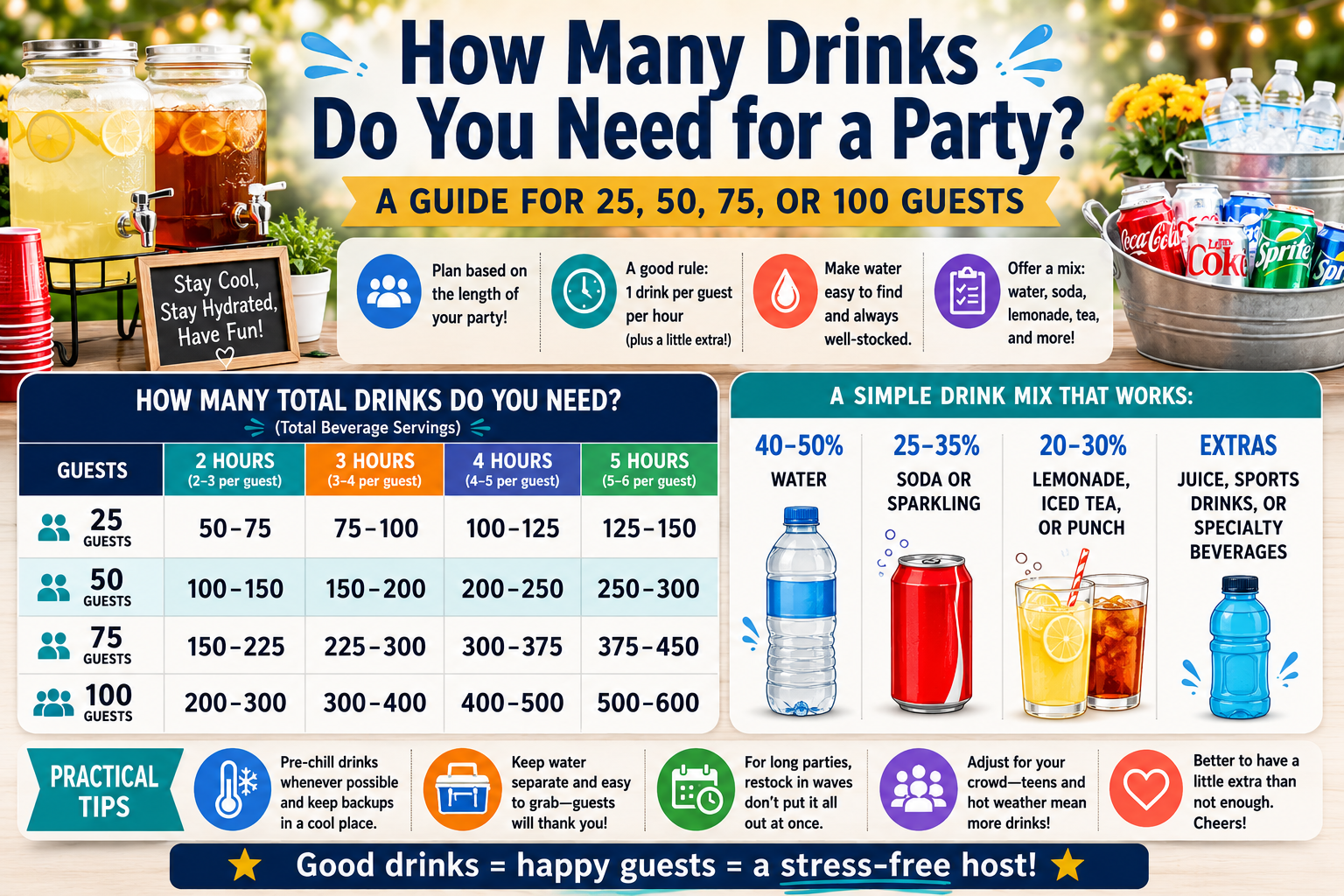
Quick Answer
A practical starting point is approximately one drink per guest per hour, with a possible extra serving during the first hour. For a three hour party, plan roughly 3 to 4 beverage servings per guest.
Food usually gets most of the attention when planning a party.
But drinks are one of the easiest things to underestimate.
You buy a few cases of water.
A couple of 2 liter bottles of soda.
Maybe some lemonade.
The coolers look completely full when the party starts.
Then it is 3:00 PM, the temperature has climbed, half the water is gone, someone asks if there is any more Diet Coke, and the lemonade dispenser is down to ice and lemon slices.
So how many drinks do you actually need for a party?
A useful starting point for a typical party is approximately one drink per guest per hour, with some party planning formulas allowing for an extra drink during the first hour when guests arrive thirsty and begin eating. That puts many three to four hour parties around 3 to 5 beverage servings per guest, depending on the weather, crowd, event length, and what else is being served.
For a three hour backyard party, that means 50 guests could easily go through 150 to 200 total beverage servings.
That does not mean 200 cans of soda.
Those servings should be divided among water, soda, lemonade, iced tea, sparkling water, juice, punch, or whatever beverages make sense for your party.
For families planning graduations, birthdays, showers, reunions, school events, and backyard celebrations throughout Albany, Colonie, Loudonville, Latham, Delmar, Bethlehem, Clifton Park, Saratoga Springs, Niskayuna, Troy, and the surrounding Capital Region, here's a practical way to calculate drinks without filling your garage with cases you will still be drinking in October.
1. Start With the Length of the Party
Guest count is only half the equation.
Fifty guests attending a two hour birthday party will not drink the same amount as 50 guests staying for a five hour graduation open house.
A practical starting range is:
| Party length | Starting drinks per guest |
|---|---|
| 2 hours | About 2 to 3 |
| 3 hours | About 3 to 4 |
| 4 hours | About 4 to 5 |
| 5 hours | About 5 to 6 |
These are total beverage servings, not servings of every beverage you offer.
Current drink planning tools use similar guest count plus duration calculations, with approximately one drink per person per hour as a baseline and a possible first hour increase.
Use the lower end for a shorter, relaxed indoor gathering.
Move higher for:
hot outdoor parties,
active children's parties,
long graduation open houses,
events with backyard games,
or any party where people will be outside for several hours.
2. How Many Drinks Do You Need for a 3 Hour Party?
For a typical three hour party, using approximately three to four drinks per person gives you:
| Guests | Total drink servings |
|---|---|
| 25 | 75 to 100 |
| 50 | 150 to 200 |
| 75 | 225 to 300 |
| 100 | 300 to 400 |
Again, this is the total drink table, not just soda.
A 50 person party might have 175 total servings divided among bottled water, soda, lemonade, and iced tea.
That is much more realistic than buying 175 cans of Coke.
3. How Many Drinks Do You Need for a 4 Hour Party?
Graduation open houses commonly run longer than children's birthday parties.
For approximately four hours, start closer to four to five drinks per guest.
| Guests | Total drink servings |
|---|---|
| 25 | 100 to 125 |
| 50 | 200 to 250 |
| 75 | 300 to 375 |
| 100 | 400 to 500 |
Do not panic when you see 500 drinks for 100 guests.
A bottle of water counts as one.
A cup of lemonade counts as one.
A soda counts as one.
Someone who drinks two waters, one lemonade, and one soda during a four hour summer graduation has consumed four beverage servings.
That adds up quickly.
4. Water Should Be the Foundation of the Drink Plan
If the party is outdoors, water should be the beverage you are least worried about running out of.
Do not bury it underneath soda in one giant cooler.
Make it visible.
For many backyard parties, we would rather finish the event with an unopened case of water than discover midway through the afternoon that the only drinks left are warm soda.
For a warm weather party, a practical starting point is at least one to two bottles of water per guest, with more available when temperatures are high or guests are especially active.
If you use dispensers instead of bottles, keep an easy way to refill them.
And remember that children may take a water, leave it somewhere, and later take another.
Real parties are not perfectly efficient.
5. Don't Make Soda Your Entire Beverage Calculation
This is where hosts often overbuy.
If your calculation says 200 total drinks, you do not need 200 sodas.
Guests will also drink:
water,
lemonade,
iced tea,
seltzer,
juice,
or other options.
Your beverage selection should divide the demand.
One simple family party mix might look approximately like this:
40 to 50% water
25 to 35% soda or sparkling beverages
20 to 30% lemonade, iced tea, punch, or another batch drink
That is not a universal catering formula.
It is a practical way to think about variety.
Adjust it based on your guests.
A children's birthday may need more water and juice.
A graduation with lots of teenagers may go through more soda.
A summer shower may use far more lemonade and iced tea.
6. How Much Soda Do You Need for 25 Guests?
Let's say your three hour party will have 25 guests.
You estimate 75 to 100 total drinks.
If approximately one third are soda, you would need roughly:
25 to 35 soda servings.
If you are buying cans, that is easy:
around 25 to 35 cans.
You may decide to buy two 18 packs or a combination of regular and diet varieties.
If you are buying 2 liter bottles, keep reading.
7. How Much Soda Do You Need for 50 Guests?
For 50 guests at a three hour party, our total starting estimate is approximately 150 to 200 beverage servings.
If soda accounts for roughly one third:
plan around 50 to 70 soda servings.
That could mean:
50 to 70 cans,
or approximately 7 to 9 2 liter bottles when using a conservative eight 8 ounce servings per bottle.
Current soda calculators targeting the same search question land in a similar general range depending heavily on party duration and whether other beverages are offered.
If your family hardly drinks soda, reduce it.
If every teenager in attendance drinks two cans, increase it.
The guest list knows more than the formula.
8. How Much Soda Do You Need for 75 Guests?
Using the same approach:
A three hour party may need approximately 225 to 300 total drinks.
If around one third are soda:
75 to 100 soda servings is a reasonable starting range.
That could be approximately:
75 to 100 cans,
or roughly 10 to 13 2 liter bottles.
You do not need thirteen bottles of cola.
Spread the quantity across the flavors people actually drink.
9. How Much Soda Do You Need for 100 Guests?
For 100 people:
three hours × approximately three to four drinks gives you 300 to 400 total beverage servings.
If soda makes up around one quarter to one third:
plan approximately 75 to 130 soda servings, depending on your crowd.
That might mean roughly:
4 to 6 cases of cans,
or around 10 to 16 2 liter bottles.
At this size, buying a random assortment becomes expensive quickly.
Plan the mix intentionally.
10. How Many Servings Are in a 2 Liter Bottle?
A 2 liter bottle contains approximately 67.6 fluid ounces.
If you pour 8 ounce servings, that is theoretically about 8.5 servings.
Ice changes the amount of actual soda in each cup, which is why some party calculators estimate closer to 10 party size servings from a 2 liter bottle.
For easy planning, we prefer the conservative approach:
Count one 2 liter bottle as approximately eight full servings.
If you get nine or ten, great.
It is better than building the entire drink plan around perfectly measured pours that will never happen at an actual backyard party.
11. Cans vs. 2 Liter Bottles: Which Is Better?
Both work.
Cans are easier when:
the party lasts several hours,
guests arrive in waves,
you want portions to remain individually cold,
or you do not want opened bottles sitting around getting flat.
One can equals one easy to count serving.
2 liter bottles are useful when:
you are serving a large group at once,
you have cups and ice already,
you want to reduce packaging,
or cost per ounce matters more than convenience.
For a long graduation open house, cans can be particularly convenient because unopened drinks remain usable throughout the event.
For a short birthday party, a few 2 liter bottles may be all you need.
12. Don't Buy Equal Amounts of Every Soda
This is another common mistake.
You buy:
four cola,
four diet cola,
four lemon lime,
four root beer,
four orange,
and four ginger ale.
Then every cola bottle is empty and you have four unopened orange sodas.
Variety is good.
Equal quantities are not necessary.
Use what you know about your crowd.
For many parties, a simple starting assortment might emphasize:
regular cola,
a diet or zero sugar option,
and lemon lime.
Then add one or two specialty options if your family actually drinks them.
You are stocking a party.
Not opening a convenience store.
13. How Much Lemonade Do You Need?
One gallon contains 128 ounces.
At an 8 ounce serving size, that gives you approximately 16 servings per gallon.
So:
| Lemonade servings | Approximate gallons |
|---|---|
| 25 servings | 1.5 to 2 gallons |
| 50 servings | About 3 to 3.5 gallons |
| 75 servings | About 5 gallons |
| 100 servings | About 6.5 gallons |
Remember that ice takes up room in the cup, so actual yield may be slightly higher.
But do not count on every person taking a tiny cup.
For a hot outdoor party, lemonade can disappear quickly.
14. The Same Math Works for Iced Tea and Punch
A gallon of iced tea or punch also gives approximately sixteen 8 ounce servings before accounting for ice.
So if you expect about 50 servings of iced tea:
plan approximately three to four gallons.
If you are offering both lemonade and iced tea, you do not need enough of each for every guest.
They are sharing the beverage demand.
That is the theme of this entire guide:
calculate the total first, then divide it among your choices.
15. Don't Forget Children When Planning Drinks
Children may drink smaller portions.
They may also lose cups faster.
A child gets lemonade.
Runs to Giant Connect Four.
Puts the cup beside a chair.
Five minutes later:
“Can I have a drink?”
Another cup appears.
That is one reason beverage consumption at family parties does not follow perfect serving size math.
If a lot of younger children are attending, smaller cups can help reduce waste.
Put markers near disposable cups so guests can write their names.
That tiny step can save dozens of abandoned drinks during a larger party.
16. Teenagers Can Drink a Surprising Amount
Teenagers should not automatically be counted as children in your drink calculation.
At a graduation party, teenagers may be:
playing games,
moving around the yard,
eating salty food,
and staying for several hours.
A teenager can easily go through several beverages.
For a high school graduation, count them much closer to adults than small children when calculating your overall drinks.
17. Hot Weather Changes Everything
A 75 degree afternoon and a 92 degree afternoon should not have identical drink plans.
When the forecast is hot, increase the water.
Make water extremely visible.
Keep backup cases cold whenever possible.
Put a second water location near games or activity areas if the property is large.
Your current Three Sisters site already encourages hosts to plan backyard parties around local weather conditions, and your existing ice guide handles how much ice you'll need to keep those drinks cold.
The hotter the day, the less comfortable we would be with a drink calculation that barely covers the expected number.
18. Start With Cold Drinks
Do not buy eight cases of room temperature beverages Saturday morning and expect five bags of ice to magically chill them all.
Prechill what you can.
Put water and soda into the refrigerator the day before.
If refrigerator space is limited, begin with the drinks you expect to serve first.
Then the ice in your cooler is maintaining temperature instead of doing all the cooling work.
This also helps your party ice last longer.
19. Keep Backup Drinks Out of the Sun
You do not need every beverage sitting in the cooler at noon.
For a long open house, stage them.
Start with enough drinks for the first wave.
Keep additional cases:
indoors,
in a cool garage,
in another cooler,
or otherwise appropriately protected from the heat.
Refill the drink station as quantities drop.
This keeps the main station manageable and avoids having five coolers packed with melting ice at the beginning of the party.
20. A Graduation Open House Needs a Different Drink Strategy
This is important.
Suppose 75 guests will visit between 1:00 and 5:00.
Only 40 people may be there at the busiest point.
For seating, peak attendance matters.
For beverages, total attendance still matters.
All 75 people may eventually want something to drink.
So do not calculate drinks for only the 40 people who will be there simultaneously.
This is the same principle we use when planning food for an open house.
Chairs can turn over.
A bottle of water that someone drank at 1:30 cannot be reused when the next guest arrives at 3:00.
21. A Practical Drink Plan for 25 Guests
Imagine a three hour backyard birthday.
You want approximately 75 to 100 beverage servings available.
A simple starting mix might be:
30 to 40 waters
25 to 30 sodas
20 to 30 servings of lemonade or another batch drink
That puts you around the expected range without offering six different beverages.
If most of the guests are children, shift more toward water, lemonade, juice, or whatever makes sense for your crowd.
22. A Practical Drink Plan for 50 Guests
For a three hour party, start around 150 to 200 total beverage servings.
An example might be:
70 to 80 bottles of water
50 to 60 sodas
40 to 60 servings of lemonade or iced tea
That could look like:
three to four cases of water,
roughly two to three cases of assorted soda,
and approximately three gallons of lemonade.
You can adjust those proportions significantly.
The important number is the total.
23. A Practical Drink Plan for 75 Guests
Start around 225 to 300 beverage servings for approximately three hours.
One example:
100 to 125 waters
75 to 90 sodas
60 to 85 servings of lemonade, tea, or punch
At this size, one drink cooler may become crowded.
Consider separating water from soda or using a dispenser for the batch drink.
That can also make the station much easier for guests to use.
24. A Practical Drink Plan for 100 Guests
For approximately three hours, start around 300 to 400 total beverage servings.
An example family party mix might include:
140 to 175 waters
100 to 125 sodas or sparkling drinks
75 to 100 servings of lemonade, tea, or punch
For a four hour graduation open house, especially on a hot day,those numbers can move considerably higher.
Do not treat 100 guests like a slightly larger 50 person party.
At this size, drinks need their own system.
25. Keep Water Separate at Larger Parties
Once you reach around 50 to 100 guests, consider giving water its own obvious location.
Why?
Because water is the thing people should be able to grab quickly.
Guests looking only for water should not have to dig through a cooler containing eight soda flavors.
You might have:
one cooler for water,
one cooler for soda,
and one dispenser table for lemonade and iced tea.
That is easier for guests.
It is also easier for the host to see what needs refilling.
26. Don't Forget the Cups
If you are serving only bottles and cans, you may need relatively few cups.
If you have:
lemonade,
iced tea,
punch,
or 2 liter soda,
cups become part of your drink calculation.
Three Sisters Party Co. already has a dedicated guide for calculating plates, cups, napkins, and forks, so you do not need to guess at those separately.
Use your serving style to decide whether every guest actually needs multiple cups.
Markers beside cups can also reduce waste.
27. Don't Forget the Ice
Drink quantity and ice quantity are related, but they should not be treated as the same calculation.
You may need ice for:
coolers,
cups,
drink dispensers,
and possibly snow cones.
Your current Three Sisters planning content already includes a dedicated How Much Ice Do You Need for a Party? guide, so calculate the drinks first and then use the ice guide to determine how much ice your particular setup requires.
This keeps you from double counting or buying ice based on guest count alone.
28. If You're Serving Alcohol, Don't Reduce the Water
This guide intentionally focuses on the nonalcoholic drinks that nearly every Three Sisters Party Co. event needs:
water,
soda,
lemonade,
iced tea,
juice,
punch,
and similar family party beverages.
If alcohol is also served, your soda and batch drink mix may change.
Water should still remain readily available.
Guests drinking alcohol also drink water and other nonalcoholic beverages, so do not remove those guests entirely from the nonalcoholic plan.
Current drink calculators make the same distinction: adding alcoholic options changes the beverage mix but does not eliminate the need for water and other choices.
29. Don't Put Every Drink Out at Once
This is particularly useful for a graduation party.
Start with:
one stocked water cooler,
one stocked soda cooler,
and the first batch of lemonade or tea.
Keep backups protected.
As the party continues, replenish.
That gives you a much clearer picture of actual consumption.
If you discover everyone is drinking water and almost nobody is drinking soda, you can put more water on ice instead of chilling another entire case of soda unnecessarily.
30. Use the First Hour as Your Reality Check
After the first hour, look at the drinks.
How much water disappeared?
Which soda is going fastest?
Has the lemonade dispenser been refilled already?
Are people actually using the sparkling water?
This gives you time to adjust.
Bring more water out.
Put additional soda on ice.
Mix the second batch of lemonade.
Move slow selling beverages out of the way.
The best drink plan can still be adjusted once real guests replace theoretical ones.
31. What Three Sisters Party Co. Customers Should Know
Three Sisters Party Co. provides party equipment including tables, folding chairs, concession machines, coffee urns, backyard games, food warming mats, outdoor movie equipment, and party packages throughout the Capital Region. Current inventory and package details are listed on the Packages & Pricing page.
Our rentals do not include the general beverages for your party unless a particular current package specifically says otherwise.
But drinks affect the rest of your setup.
A 75 person beverage plan may need:
a dedicated drink table,
multiple coolers,
extra cups,
more ice,
and enough space for guests to gather without blocking the buffet.
That is why we recommend planning drinks while you are planning the physical layout, not on the way home from the grocery store the morning of the party.
Frequently Asked Questions
How many drinks do I need per person for a party?
A practical starting point is approximately one drink per person per hour, with some planning methods adding an extra serving during the first hour. For a three hour party, roughly three to four drinks per guest is a useful starting range; for four hours, roughly four to five.
How many drinks do I need for 50 guests?
For a three hour party, approximately 150 to 200 total beverage servings is a reasonable starting point. For four hours, plan closer to 200 to 250. Divide the total among water, soda, lemonade, tea, and your other beverage options.
How much soda do I need for 50 people?
If soda represents roughly one third of a three hour drink plan, around 50 to 70 soda servings is a practical starting point. Current soda specific calculators also vary substantially depending on event length and what other drinks are served.
How many 2 liter bottles do I need for 50 guests?
If you need approximately 50 to 70 soda servings, plan around seven to nine 2 liter bottles using a conservative estimate of roughly eight full 8 ounce servings per bottle.
How many cans of soda do I need for 50 guests?
If soda is one of several beverage choices, approximately 50 to 70 cans can be a reasonable starting point for a three hour party. Adjust for the length of the event and what your guests actually drink.
How much lemonade do I need for 50 guests?
If you want approximately 40 to 60 lemonade servings, plan about 2.5 to 4 gallons. One gallon provides approximately sixteen 8 ounce servings before considering ice.
How many bottles of water do I need for 50 guests?
For an outdoor party, start with at least 50 to 100 bottles depending on weather, event length, activities, and what other beverages are available. For hot summer events, we would rather have extra water than calculate it too tightly.
Do I need more drinks for an outdoor party?
Usually, especially when the weather is warm or guests are active. Increase water first rather than simply adding more soda.
Do I need more drinks for a graduation open house?
Possibly. Graduation open houses often last several hours. Calculate beverages using the total number of guests expected throughout the event rather than only the number present at peak attendance.
Should I use cans or 2 liter bottles?
Cans are easier to portion, chill, and serve over a long event. 2 liter bottles can be less expensive per serving and work well when you already have cups and ice. Either can work.
Calculate the Total First, Then Decide What Everyone Is Drinking
The easiest way to plan party drinks is not:
How many cases of soda should I buy?
Start with:
How many total beverage servings will my guests need?
For a typical party:
2 hours: about 2 to 3 drinks per guest
3 hours: about 3 to 4 drinks per guest
4 hours: about 4 to 5 drinks per guest
Then divide that total among:
water,
soda,
lemonade,
iced tea,
juice,
punch,
or whatever your guests actually enjoy.
Keep water easy to find.
Prechill as much as possible.
Do not put every drink on ice at once.
Keep backups protected.
Use smaller cups when appropriate.
And check consumption after the first hour so you can adjust before anything runs out.
Because nobody remembers whether you bought exactly the right number of soda bottles.
They remember standing beside an empty cooler at a hot July graduation wondering:
“Is there anything left to drink?”
Three Sisters Party Co. provides tables, chairs, concession machines, coffee urns, backyard games, outdoor movie equipment, food warming mats, and party rentals for graduations, birthdays, showers, family reunions, and backyard celebrations throughout Albany, Colonie, Loudonville, Latham, Delmar, Bethlehem, Clifton Park, Saratoga Springs, Niskayuna, Troy, and the surrounding Capital Region.
View our Packages and Pricing, use the Party Rental Calculator, or check availability for your event date and address.
For families planning graduations, birthdays, showers, reunions, school events, and backyard celebrations throughout Albany, Colonie, Loudonville, Latham, Delmar, Bethlehem, Clifton Park, Saratoga Springs, Niskayuna, Troy, and the surrounding Capital Region.
See packages and pricing, try the party rental calculator, or check availability.