How to Keep Tablecloths From Blowing Away at an Outdoor Party
By Katie, Three Sisters Party Co. ·
Quick Answer
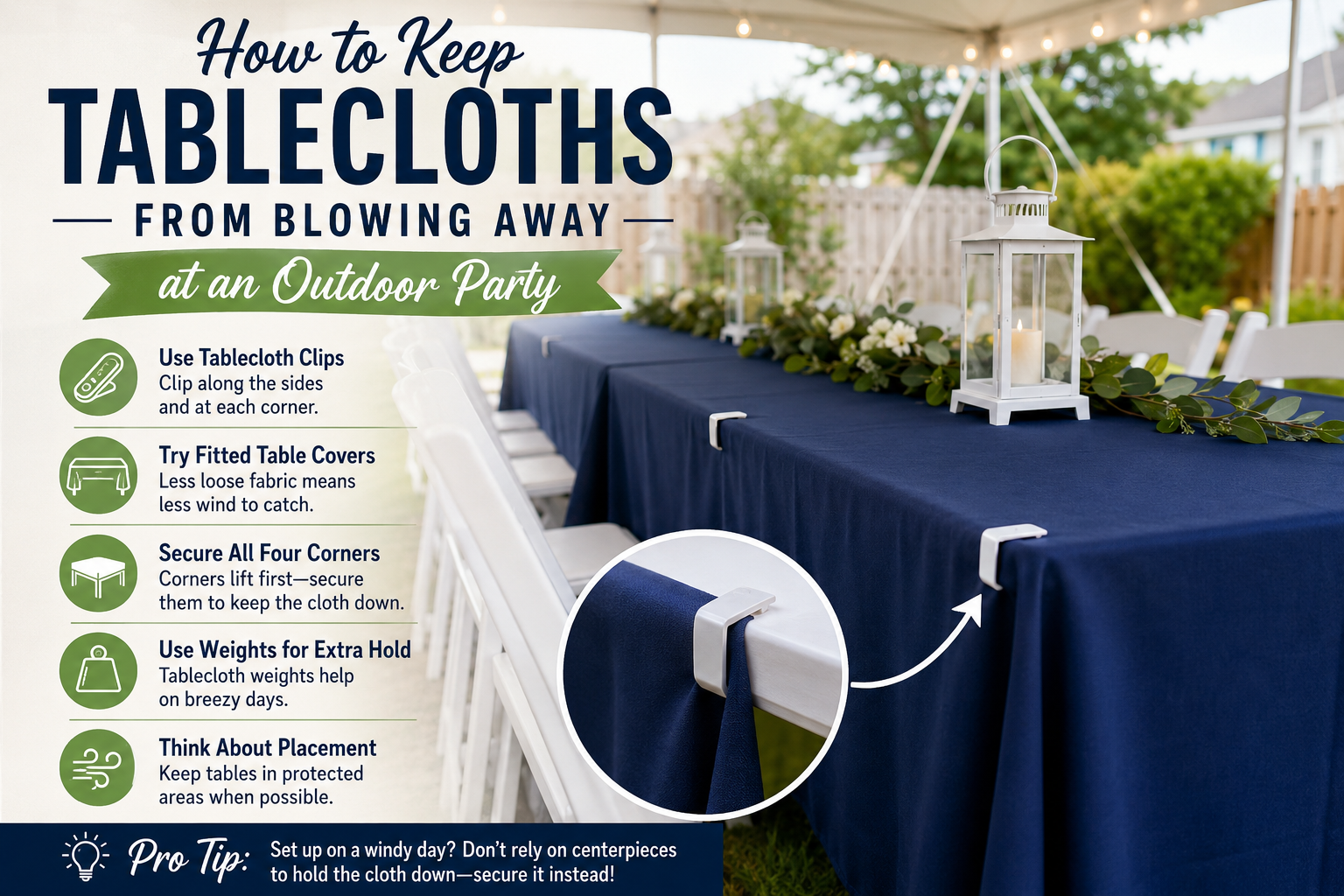
Tablecloth clips are the easiest fix: secure both long sides and all four corners of the table instead of relying on centerpieces. On breezy days a fitted table cover or a shorter drop beats a loose floor length cloth, and food, dessert, and concession tables should sit in a more protected part of the yard.
You can spend an hour making your backyard tables look perfect and watch the whole setup change with one strong gust of wind.
A tablecloth lifts. The corners start flapping. A centerpiece shifts. Someone puts a drink on the edge to hold everything down. Five minutes later, another tablecloth is halfway across the lawn.
It is one of those small outdoor party problems that does not seem important until you are standing in the backyard trying to fix it shortly before guests arrive.
Fortunately, keeping tablecloths in place usually does not require anything complicated.
The best solution depends on the type of tablecloth you are using, how windy the day is expected to be, and whether guests will be sitting at the table or it will be used for food, gifts, desserts, or concessions.
For families planning graduation parties, birthdays, showers, family reunions, school celebrations, and backyard events throughout Albany, Loudonville, Latham, Colonie, Delmar, Bethlehem, Clifton Park, Saratoga Springs, Niskayuna, Troy, and the surrounding Capital Region, here are the easiest ways to keep outdoor tablecloths where they belong.
1. Start With the Right Size Tablecloth
Before adding clips or weights, make sure the tablecloth actually fits the table.
Three Sisters Party Co. rents 6 foot rectangular folding tables, so the tablecloth needs enough material to cover the tabletop without creating an excessive amount of loose fabric for the wind to catch.
For a standard 6 foot rectangular table, we previously covered several common tablecloth sizes in our tablecloth sizing guide. A 60 by 102 inch cloth provides a moderate drop, while a 90 by 132 inch cloth creates a much longer, floor length look.
That difference matters outdoors.
A long tablecloth may look beautiful, but it also creates more fabric for the wind to move.
If you know the party will be outside on a breezy day, a shorter drop or fitted table cover may be easier to manage than a loose floor length cloth.
2. Tablecloth Clips Are Usually the Easiest Solution
Tablecloth clips are one of the simplest options for outdoor parties.
They slide over the tablecloth and edge of the table, holding the fabric against the tabletop.
For a 6 foot rectangular table, place clips along both long sides rather than using only one at each corner.
You generally want the cloth secured in several places so the wind cannot get underneath one large section and lift it.
Clear or white clips tend to blend into most party setups.
Before buying clips, check the opening size. Some inexpensive clips are designed for thin household tables and may not fit thicker folding tables.
Test them before party day rather than discovering during setup that they will not slide onto the table.
3. Fitted Tablecloths Are Excellent for Windy Days
If wind is a major concern, fitted table covers are one of the easiest solutions.
Instead of hanging loosely from the table, the material stretches around the tabletop and often wraps around or toward the legs.
There is much less loose fabric for the wind to grab.
Fitted covers work especially well for:
- food tables
- concession stations
- drink stations
- registration tables
- school events
- vendor style setups
- outdoor parties in exposed areas
They create a slightly different look than a traditional loose tablecloth, so the choice depends on the style of your event.
For a casual graduation party or backyard birthday, though, the practical advantage may be worth it.
4. Secure All Four Corners
Corners are usually where the problem begins.
A gust lifts one corner. Air moves underneath the cloth. Then a much larger section of the tablecloth begins moving.
Even if you do not secure every inch of the table, securing the corners makes a significant difference.
Use tablecloth clips or another tablecloth specific fastener near each corner.
Do not use staples, nails, screws, tacks, or anything that punctures the rental table.
Rental equipment should never be permanently modified to hold decorations or linens in place.
5. Use Hidden Fasteners Under the Table
When you do not want clips visible from above, another option is securing the tablecloth underneath the tabletop.
One common outdoor tablecloth technique uses clips attached to the fabric with elastic or small bungee style tension underneath the table. Today's Homeowner demonstrates a version using tarp clips and small bungee cords to hold the cloth from below.
The important distinction with rental tables is that the fastener should secure the tablecloth, not damage or permanently attach to the table.
Do not drill into, tape aggressively to, staple, or otherwise alter rented furniture.
Also avoid creating cords or loops where guests could catch their feet.
Everything should remain underneath the tabletop and away from the seating area.
6. Tablecloth Weights Can Help With Light Breezes
Tablecloth weights attach to the lower edges of the cloth and add enough weight to reduce movement.
They are available in many styles, including simple metal clips and decorative designs.
For a backyard party, use several rather than expecting one weight on each end to control a large tablecloth.
They work best in a light breeze.
If the wind is strong enough to repeatedly lift the entire cloth, weights hanging from the bottom may not solve the problem by themselves. Clips or a fitted cover will usually provide better control.
Also consider where guests will sit.
Heavy decorations hanging from the cloth should not bump against knees or become something children can pull.
7. Do Not Depend on Centerpieces to Hold the Cloth Down
It is tempting to place a flower vase, drink dispenser, serving tray, or heavy centerpiece on top of the tablecloth and assume the problem is solved.
That only holds down one small part of the fabric.
The corners can still lift.
More importantly, if the cloth moves strongly enough, anything sitting on top of it can move too.
That becomes especially problematic with:
- glass vases
- candles
- drink dispensers
- cakes
- food trays
- hot serving dishes
- coffee urns
Secure the tablecloth independently.
Then place the centerpiece or serving equipment on the stable table.
Your decorations should decorate the table, not function as the tablecloth anchoring system.
8. Use Extra Care Around Food and Concession Tables
A moving tablecloth is annoying on a guest table.
It can become a much bigger problem on a food table.
Buffet tables may contain serving trays, warming equipment, drinks, utensils, desserts, or condiments.
Concession areas may include popcorn, cotton candy, or snow cone equipment.
The table surface and cloth should remain stable.
If the weather is breezy, this is a good place to use a fitted cover or multiple tablecloth clips rather than a loosely draped cloth.
Do not allow fabric to blow toward electrical equipment, warming equipment, or moving machine components.
Keep the tablecloth completely clear of plugs, vents, cords, and operating equipment.
9. Consider Using No Tablecloth on Certain Utility Tables
Not every table needs a traditional linen.
This is particularly true at an informal backyard party.
A clean white folding table used for supplies, games, backup drinks, or another behind the scenes purpose may function perfectly well without one.
Sometimes the simplest wind solution is deciding that a tablecloth does not add enough value to justify managing it.
Save your decorative linens for the tables guests will notice most: the food table, dessert table, gift table, guest seating, or another focal area.
Utility tables can remain simple.
That reduces setup time and gives you fewer things to manage if the weather changes.
10. Think About Where the Table Is Positioned
Sometimes the problem is not the tablecloth.
It is where the table is located.
A table placed in an open section of the yard may receive much more wind than one positioned closer to the house, garage, fence, or another protected area.
Watch your backyard for a few minutes before beginning setup.
Notice where the breeze is strongest.
Food, dessert, gift, and concession tables generally benefit from a more protected location anyway.
Do not block exits or create narrow walkways simply to avoid wind, but take advantage of naturally calmer areas when the layout allows it.
11. Be Careful With Plastic Tablecloths
Disposable plastic tablecloths are popular because they are inexpensive, colorful, and easy to clean up.
They are also extremely light.
That makes them particularly easy for wind to lift.
If you are using disposable plastic outdoors, plan on securing it.
Do not expect the plates and decorations to keep it down once guests begin removing items from the table.
Clips work particularly well because they can secure lightweight material without requiring additional decorations.
Check the clips periodically because very thin plastic can tear if it is pulled aggressively by strong wind.
12. Fabric Tablecloths Still Need Protection
A heavier fabric tablecloth is less likely to immediately fly off the table than thin disposable plastic.
But heavier does not mean windproof.
A long fabric drop can still act like a sail once the wind gets underneath it.
Use clips when conditions call for them.
If you are renting or borrowing linens, make sure the clips you use will not snag or damage the material.
Avoid tape directly on fabric unless you know it can be removed without leaving adhesive or damaging the linen.
13. Watch the Forecast, but Also Watch the Yard
The weather forecast can tell you that it may be breezy.
Your backyard tells you what that actually means for your setup.
Buildings, fences, trees, neighboring homes, open fields, and the direction of the wind can all change what happens at table level.
A table next to the house may barely move while another table 30 feet away experiences constant gusts.
Set one tablecloth first.
Watch it for several minutes.
If the corners repeatedly lift during setup, assume the problem will continue once the party begins.
It is much easier to add clips before plates, decorations, food, and guests are on the table.
14. Secure Tablecloths Before Decorating
The correct order makes setup easier.
First, place the table.
Then put on the tablecloth and secure it.
Only after the cloth is stable should you add centerpieces, food, decorations, signs, or place settings.
Trying to add clips after a fully decorated table is frustrating because everything has to be moved or lifted.
This is particularly important for graduation parties where tables may have framed photographs, cards, flowers, desserts, and school themed decorations.
Get the basic table setup secure first.
15. Keep a Small Wind Kit With Your Party Supplies
This is one of those inexpensive preparations that can save a surprising amount of stress.
Create a small outdoor party kit containing:
- extra tablecloth clips
- a few approved tablecloth weights
- replacement tablecloths
- paper towels
- trash bags
- zip top bags for small loose items
Store everything together.
When a windy afternoon arrives, you already have what you need.
This is much easier than sending someone to the store 30 minutes before the party.
16. Have a Plan for Paper Decorations Too
If the wind is strong enough to move the tablecloth, it will probably affect other decorations as well.
Paper signs, napkins, disposable plates, balloons, lightweight centerpieces, photo displays, and place cards may need attention.
Napkins can go inside weighted holders.
Signs can be placed in frames or sturdy stands.
Lightweight decorations can be moved indoors or to a protected area.
Balloons should be securely anchored.
Think of wind as a whole party issue instead of treating the tablecloth as the only thing affected.
17. Know When the Wind Is Too Strong
There is a difference between an annoying breeze and weather that makes an outdoor setup inappropriate.
If chairs are tipping, decorations are becoming airborne, serving items are moving, electrical equipment cannot remain protected, or guests are uncomfortable, securing a tablecloth is no longer the real problem.
The event may need to move to a protected area or use the weather backup plan.
Do not keep adding heavier objects to a table in an attempt to overpower worsening conditions.
Protect guests and equipment first.
Decorations can always be simplified.
18. What Works Best on Three Sisters Party Co. Tables?
Three Sisters Party Co. provides 6 foot rectangular folding tables for Capital Region events.
For most outdoor setups, we would keep the solution simple.
A properly sized tablecloth plus tablecloth clips is usually the easiest starting point.
For a particularly exposed or breezy location, consider a fitted table cover.
If you prefer a longer decorative linen, secure it in several places rather than relying on the weight of the fabric.
Customers handle table placement, tablecloths, decorating, and standard setup unless another arrangement has specifically been confirmed.
Never staple, screw, nail, cut, or permanently attach decorations or linens to rental furniture.
Frequently Asked Questions
What is the easiest way to keep an outdoor tablecloth from blowing away?
Tablecloth clips are usually the simplest solution. Secure several points along the table rather than only the center.
Are fitted tablecloths better for outdoor parties?
They can be. Fitted covers have much less loose material for the wind to catch, making them especially practical for exposed outdoor setups.
Can I use tape to keep a tablecloth down?
Tape may leave adhesive behind or fail when surfaces become dusty, damp, or hot. Tablecloth clips or fitted covers are usually cleaner options for rental tables.
Can I staple a tablecloth to a rental table?
No. Do not staple, nail, screw, cut, drill into, or permanently modify rental equipment.
How do I keep a plastic tablecloth from blowing away?
Secure it with clips around several sides of the table. Lightweight disposable plastic usually needs more help in the wind than heavier fabric.
Do tablecloth weights work?
They can work well during light breezes. For stronger or repeated gusts, tablecloth clips or fitted covers generally provide better control.
Should I use a floor length tablecloth outdoors?
You can, but longer fabric gives the wind more material to catch. Secure it carefully or consider a shorter drop when windy conditions are expected.
Should every outdoor table have a tablecloth?
No. Utility and supply tables may not need them. Keeping some tables uncovered can simplify an informal backyard setup.
What should I do if the wind becomes very strong?
Move loose decorations and equipment to a protected location and use your weather backup plan. If conditions are affecting chairs, electrical equipment, food service, or guest comfort, the issue has moved beyond simply securing a tablecloth.
Keep the Tablecloth Simple So You Can Enjoy the Party
A windy day does not have to mean chasing tablecloths around the backyard.
Start with a properly sized cloth. Secure the corners. Use several tablecloth clips instead of relying on centerpieces. Consider fitted covers for particularly breezy locations, and think about wind before placing the food, dessert, or concession tables.
Most importantly, solve the problem during setup.
Once the guests arrive, you should not have to spend the afternoon fixing the same tablecloth every ten minutes.
Three Sisters Party Co. provides tables, chairs, backyard games, concession machines, outdoor movie equipment, coffee urns, food warming mats, and party packages for celebrations throughout Albany, Colonie, Loudonville, Latham, Delmar, Bethlehem, Clifton Park, Saratoga Springs, Niskayuna, Troy, and the surrounding Capital Region.
View our Packages and Pricing, use the Party Rental Calculator, or check availability for your event date and address.
Katie
Written for families hosting backyard parties in Albany, Colonie, Latham, Loudonville, Delmar, Bethlehem, Clifton Park, Saratoga Springs, Niskayuna, and Troy.
See packages and pricing, try the party rental calculator, or check availability.